What is a chargeback, and how do you dispute a card payment?
A chargeback is the reversal of a card payment that your card issuer raises against the merchant under the card scheme's rules, for a payment you made that went wrong. A payment you never made is refunded under EU law instead, by the end of the next business day after you report it.
A chargeback reverses a card payment when the merchant won't put it right, and it is one of two routes back to your money: EU law covers payment cards used without your consent, and the card scheme's dispute rules cover payments you made that went wrong.
What is a chargeback?
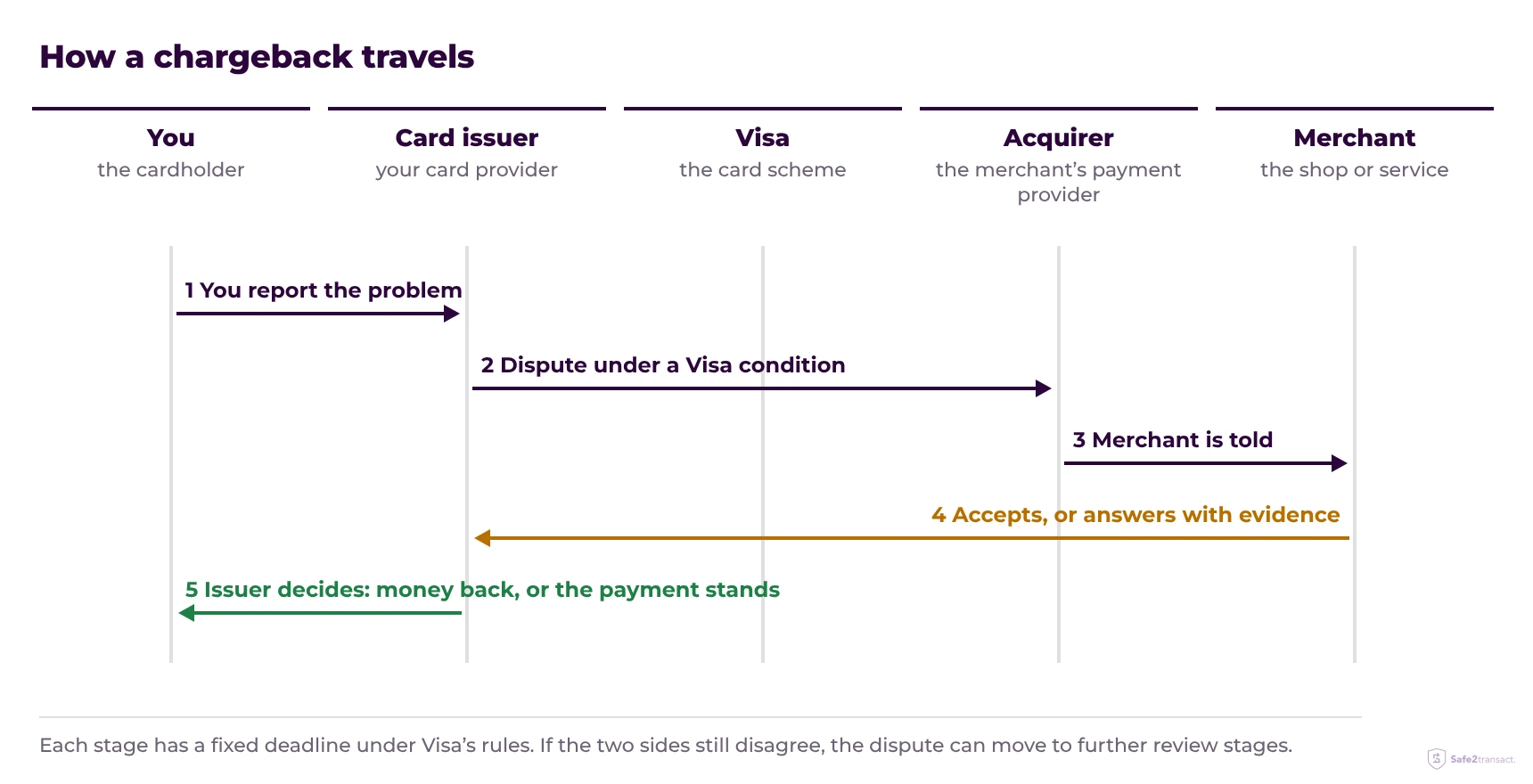
A chargeback is the reversal of a card payment that your card issuer, the company that gave you the card, raises against the merchant through the card scheme.
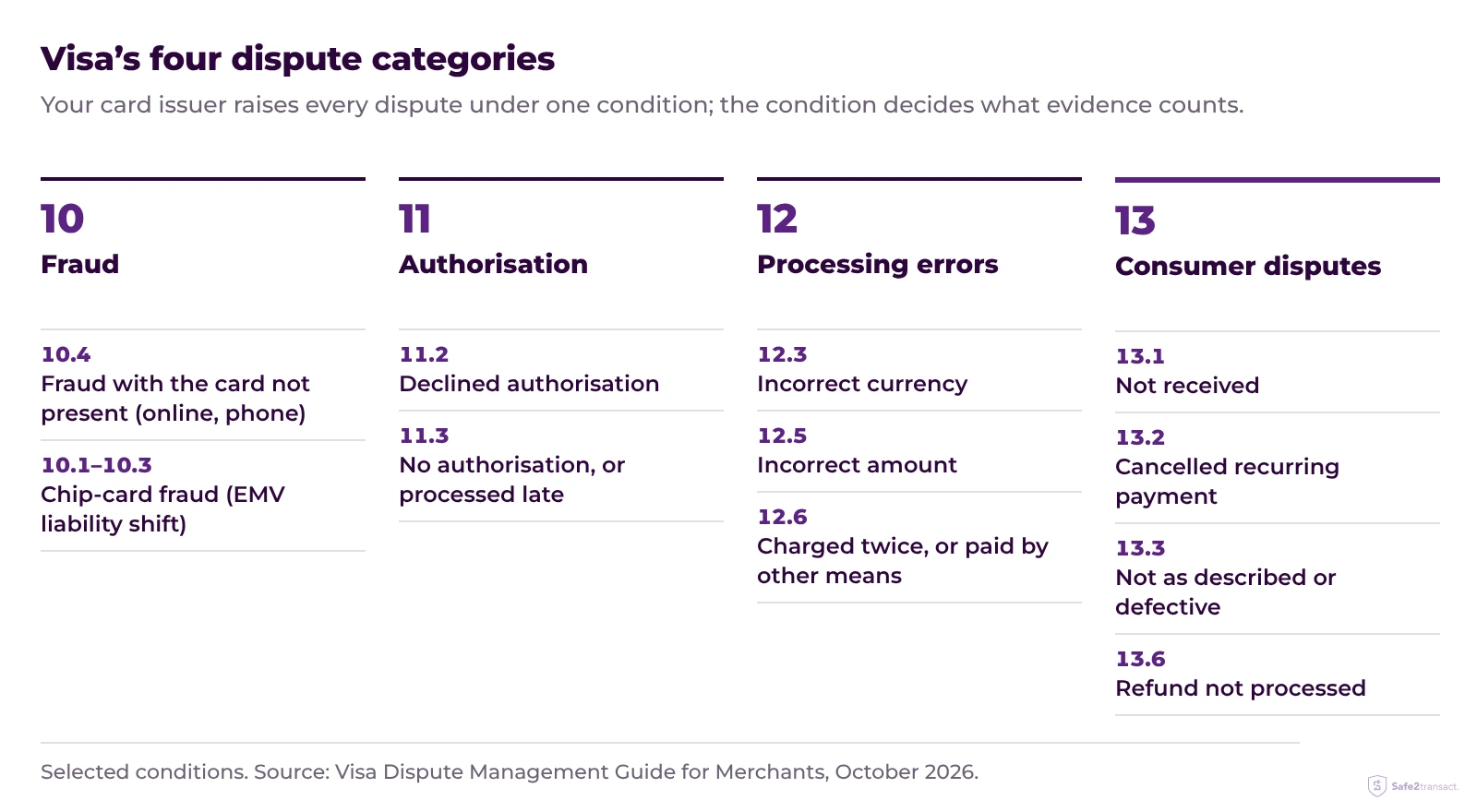
Chargebacks exist because card schemes write them into their rules, not because a law requires them. Visa calls the process a dispute and sorts every dispute into four categories, fraud, authorisation, processing errors and consumer disputes, each with numbered conditions that decide which evidence counts and which deadline applies (Visa Dispute Management Guide for Merchants, October 2026).
That one question decides the route: a payment you didn't authorise is refunded under EU law, and a payment you authorised that went wrong goes to the merchant first and then to a chargeback.
| A payment you didn't authorise | A payment you made that went wrong | |
|---|---|---|
| Examples | A stolen card used in a shop; your card details used online | Item never arrived, not as described, charged twice, subscription still charged |
| Who you contact | Your card provider, straight away | The merchant first, then your card provider |
| Basis | EU law: PSD2, Articles 71 to 74 | The card scheme's rules (Visa, Mastercard) |
| Money back | By the end of the next business day after you report it | Only if the dispute succeeds |
| Deadline | Without undue delay, at most 13 months after the debit | Set by the scheme for each dispute reason |
| Your share of the loss | At most €50 before you report a lost or stolen card, nothing after | The full amount if the dispute fails |
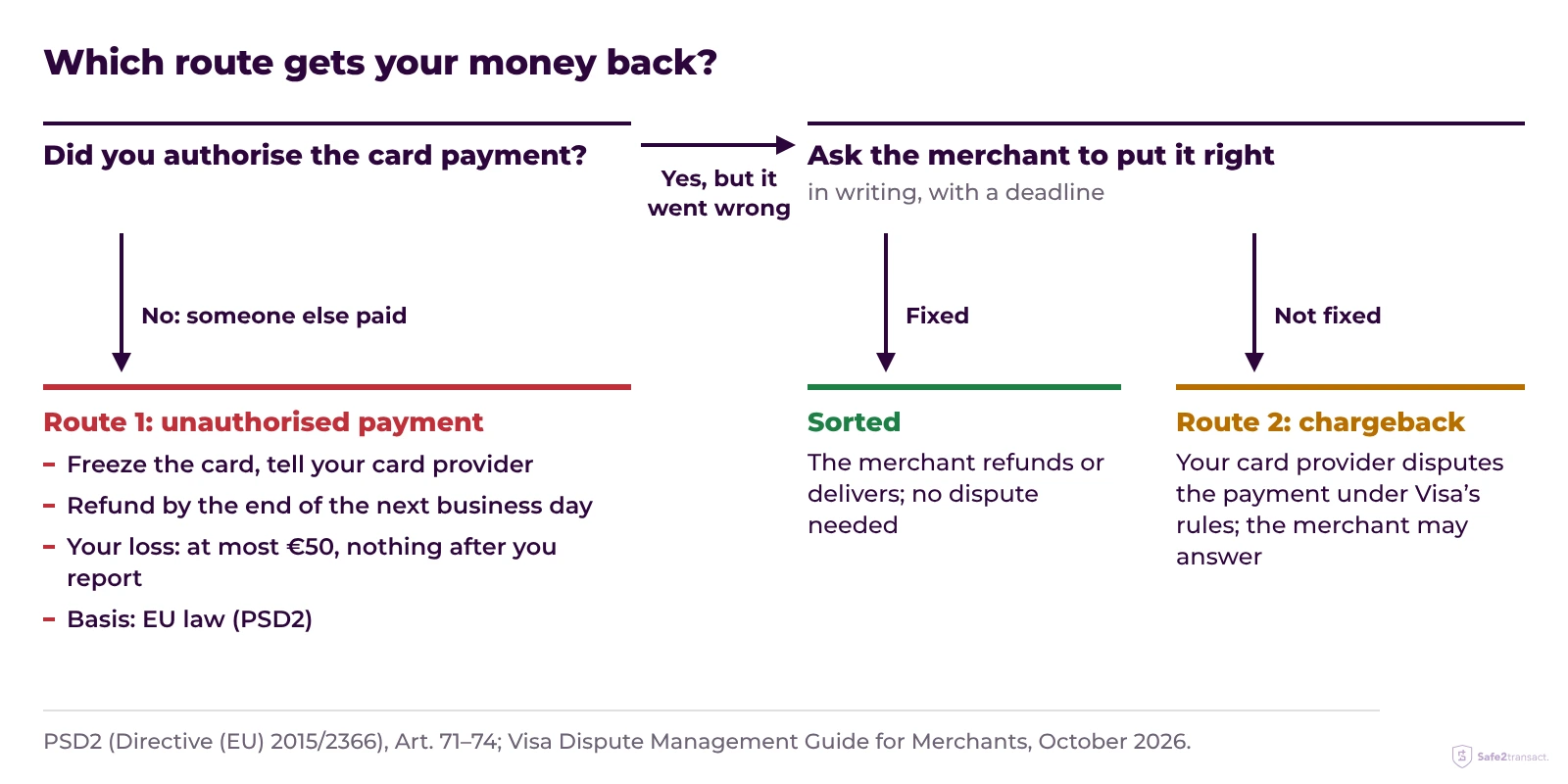
If you didn't make the payment, the law brings your money back; if you made it and it went wrong, the card scheme's rules may.
What happens if you didn't make the payment?
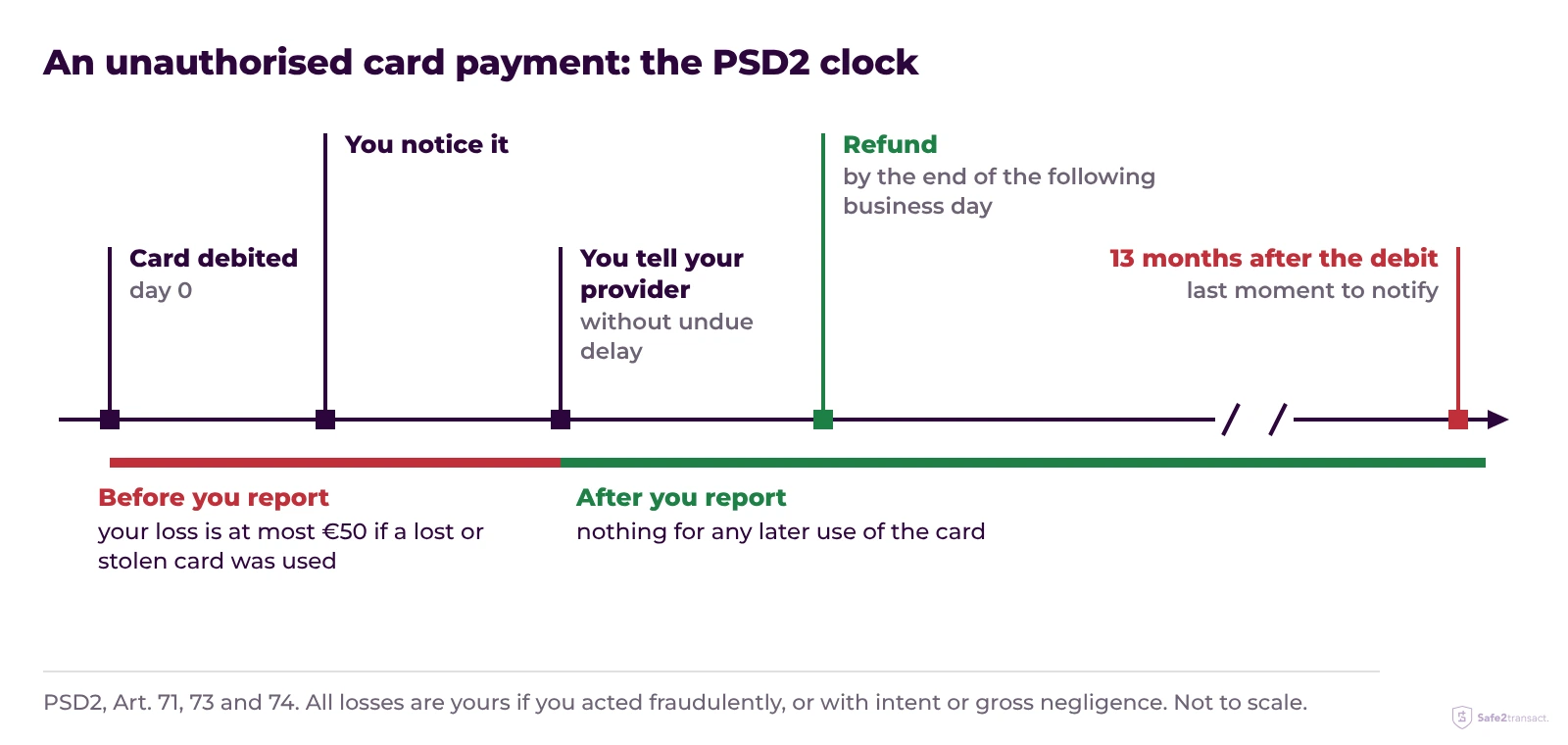
Your card provider has to refund a payment you didn't authorise by the end of the following business day after you report it, under Article 73 of the second Payment Services Directive (PSD2).
- Report quickly. Notify your provider without undue delay once you notice the payment, and at the latest 13 months after the debit date (Art. 71).
- The refund is complete. Your account is restored as if the payment had never happened. The one exception: your provider has reasonable grounds to suspect fraud and reports them in writing to the national authority (Art. 73).
- The provider proves, not you. If you deny authorising a payment, your provider has to show it was authenticated and correctly recorded, and the use of your card alone doesn't prove that you authorised it (Art. 72).
- Your loss is capped. At most €50 is yours when a lost or stolen card was used before you reported it, and nothing after you report it or when the provider didn't ask for strong customer authentication. Only fraud, or failing to keep the card and its codes safe with intent or gross negligence, makes the whole loss yours (Art. 74).
Freeze the card
Freeze it in your provider's app: new payments are declined at once.
Check every payment
Note the date, amount and merchant of every payment you don't recognise.
Report to your card provider
Say that you didn't authorise the payments, and whether the card was lost or stolen.
Follow up in writing
If no refund arrives by the end of the next business day, ask your provider in writing and, if needed, use its complaints procedure.
Card details stolen online are one reason to shop with a virtual card, which you freeze or replace without touching the card you carry. Safe2transact customers freeze the card in the app and then contact support, which guides them through a dispute for any payment they didn't make; what to do if your card is lost or stolen has every step.
Ask the merchant to put it right first, in writing, and if it doesn't, ask your card provider to dispute the payment under the card scheme's rules. A refund from the merchant is the quickest fix, and Visa's guide tells merchants to refund a legitimate complaint as soon as possible to avoid a formal dispute.
If the merchant refuses or goes silent, your card provider files the dispute under the Visa condition that matches your problem: 13.1 for an item that never arrived, 13.3 for one not as described, 12.6 for a double charge, 13.2 for a cancelled subscription still charged and 13.6 for a promised refund that never came. Mastercard has its own reason codes for the same situations.
Visa's rules give the issuer a deadline for each condition, counted from the transaction's processing date or, for goods and services not received, from the date they were expected: 120 days from that date, and no more than 540 days after processing (Visa dispute FAQ for its clients, April 2020). Your card provider needs part of that time to prepare the case, so report as soon as the merchant has had its chance.
Safe2transact has no dispute button in the app: customers contact support with the payment's date, amount and merchant, and support takes the dispute up.
Which route fits your problem?
Pick what went wrong to see the route, the steps in order, what to gather and the time limit.
What evidence should you keep for a chargeback?
Keep what shows what you were promised, what you received and what you did about it: Visa's guide says a dispute is decided on whether the evidence meets the dispute condition, not on its volume.
- The purchase: order confirmation, receipt, and the product page or terms as they were when you bought.
- The payment: date, amount and merchant name as they appear in your card transactions.
- Delivery, or its absence: tracking, the promised date, photos of what arrived.
- Your contact with the merchant: emails and chat transcripts, each with its date.
- Cancellation or return: the cancellation confirmation, proof of return postage.
Safe2transact customers find each payment's details in their card transactions.
What can a chargeback not do?
A chargeback is not a legal right to your money back: it is a process under the card scheme's rules, and your card issuer decides whether to raise it and whether it succeeds.
- The merchant can answer. The merchant may accept the dispute or send evidence that the payment was valid, and the case can move to further review stages under Visa's rules.
- It doesn't replace the merchant. A chargeback can't make a shop deliver, repair or exchange anything; it only reverses the payment.
- It isn't for second thoughts. Disputing a payment you made and got what you paid for is what the card industry calls friendly fraud. Visa's Compelling Evidence 3.0 lets an online merchant answer a fraud claim with at least two undisputed earlier payments from the same card in the previous 365 days, matching on device or IP address.
Is there a chargeback for a bank transfer?
No: a bank transfer has no chargeback, because only card schemes run one. Once a SEPA transfer has been sent, your provider can ask for the money back but can't reverse the payment on its own.
A transfer you didn't authorise is still refunded under PSD2 like a card payment, and before you pay, Verification of Payee checks the payee's name against the IBAN. A SEPA Direct Debit is the exception among bank payments: you can ask for a refund within 8 weeks of the debit, without giving a reason (PSD2, Art. 76 and 77).
Frequently asked questions
Is a chargeback the same as a refund?
No. A refund comes from the merchant, who agrees to give the money back; a chargeback takes it back from the merchant through the card scheme when it doesn't agree.
Does a chargeback cost anything?
That depends on your card provider. Some charge for handling a dispute: Safe2transact's fee schedule lists a chargeback / dispute fee of €45. A refund of a payment you didn't authorise restores your account in full (PSD2, Art. 73).
What if a hotel or car-rental company charged more than you expected?
If the exact amount wasn't set when you authorised the payment and the charge is higher than you could reasonably expect, PSD2 gives you a right to a refund in most cases. Ask within 8 weeks of the debit; your provider refunds you or explains its refusal within 10 business days (Art. 76 and 77).
Can you get your money back from a fake online shop?
If you paid by card, you can dispute the payment as goods not received (Visa condition 13.1) once the delivery date has passed and the shop doesn't answer. If you paid by bank transfer, there is no chargeback, and your provider can only try to recover the money.
IBAN and Visa card issuance and payment services are provided by Stanhope Financial UAB, a company registered in Lithuania (a member state of the European Union) with company code 305574870 and a registered address at Konstitucijos pr. 7, Vilnius, Lithuania. Stanhope Financial UAB is an Electronic Money Institution (EMI licence No. 78) authorized and regulated by the Bank of Lithuania. Access to your IBAN account and your VISA card is technically provided through the Safe2transact platform.