Virtual card vs physical card: what’s the difference?
A virtual card is a payment card that exists only as card details in an app, made for online payments; a physical card adds a chip and PIN for shops and cash machines. Most people use both.
A virtual card and a physical card differ in where they work, not in the money they spend: both are payment cards on the same card scheme, usually Visa or Mastercard, and with most providers they draw on one balance.
What is a virtual card?
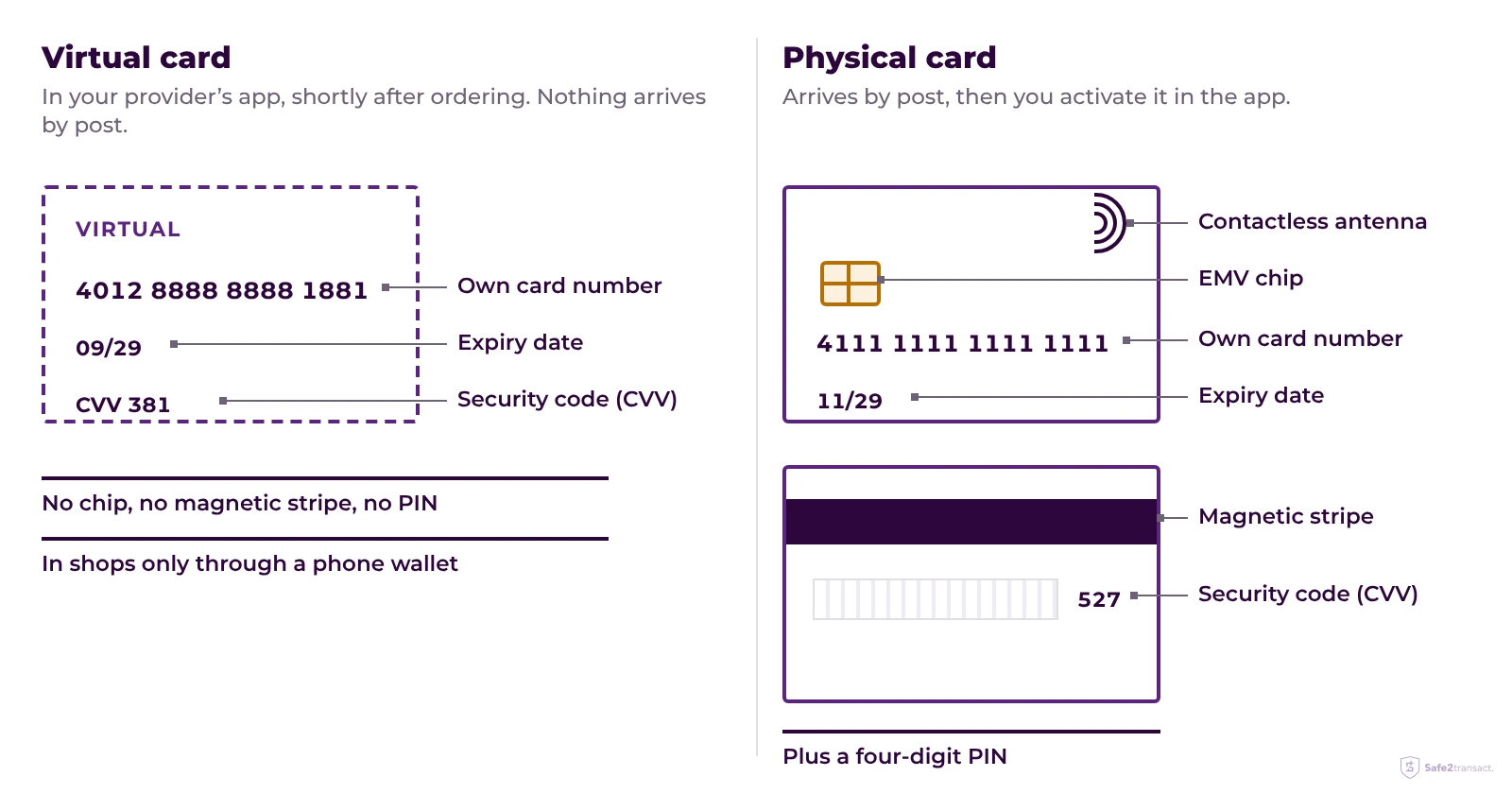
A virtual card is a payment card issued without plastic: its details appear in your provider's app, and nothing arrives by post.
The details stay behind the app's login: Safe2transact, for example, shows the full card number and CVV only after you confirm with the code from your authenticator app, and a virtual Safe2transact Visa card is free to order.
What is a physical card?
A physical card is the plastic version: the same kind of card number, expiry date and CVV, plus an EMV chip, a contactless antenna, a magnetic stripe and a four-digit PIN.
Each chip payment carries a one-time cryptogram, so a copied magnetic stripe is useless at a chip terminal. The card arrives by post: with Safe2transact, you activate the physical card in the app with the last four digits printed on it. Ordering one costs €11.99 plus €3.50 shipping at Safe2transact; other providers charge differently or nothing.
What is the difference between a virtual and a physical card?
The main difference is reach: a virtual card pays wherever card details are typed in, a physical card also pays at terminals and cash machines.
| Virtual card | Physical card | |
|---|---|---|
| Online shops and apps | Yes | Yes |
| Shop terminals | Only through a phone wallet | Chip, PIN or contactless |
| Cash machines (ATMs) | No | Yes, with the PIN |
| How you get it | In the app, shortly after ordering | By post, then activated |
| PIN | None | Four digits |
| If it is lost | Nothing to lose; freeze it if the details leak | Freeze it at once, order a replacement |
| Typical use | Online shopping, subscriptions, one-off purchases | Shops, cash, travel, hotel deposits |
The two cards are separate payment instruments with their own numbers, so blocking one leaves the other working.
Is a virtual card safer for online shopping?
Yes, mostly because a virtual card keeps the card you carry out of online checkouts. Card numbers leak online, through data breaches at shops and through phishing pages; a leaked virtual card is frozen or replaced in the app, while your physical card keeps working in shops.
Whichever card you use, the issuer, the company that issued your card, approves or declines each payment within seconds, and that check is where online security happens.
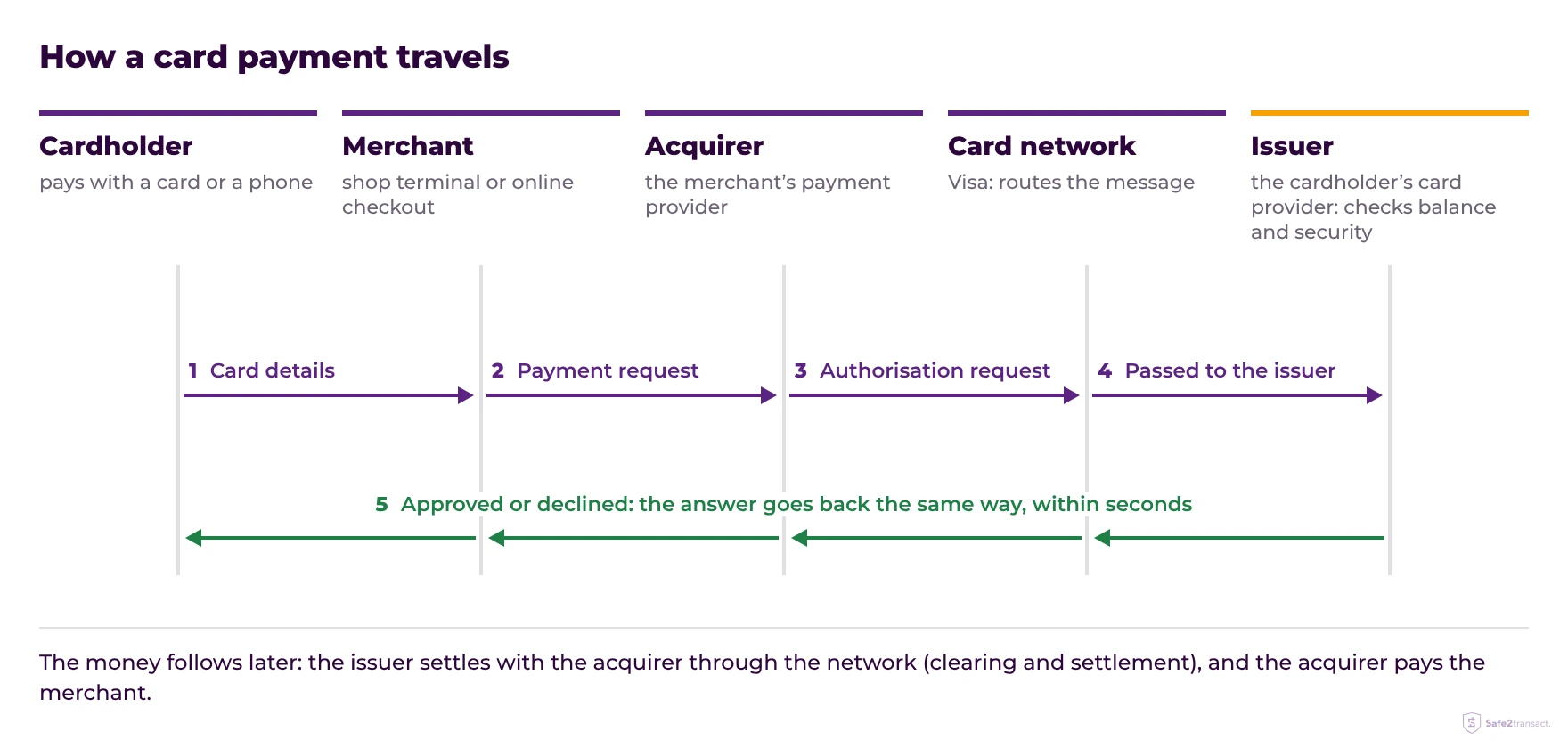
EU payment law (the second Payment Services Directive, PSD2) requires strong customer authentication for most online card payments: two of three factors, something you know, something you have and something you are. Card schemes deliver it through EMV 3-D Secure, which Visa calls Visa Secure, so your provider asks you to confirm the payment in its app or with a code. The joint report on payment fraud by the European Banking Authority and the European Central Bank (December 2025) found that card payment fraud was 17 times higher when the payment recipient was outside the EEA, where strong customer authentication is not legally required.
A virtual card changes where your card details travel, not what you pay from.
Can you add a virtual card to Apple Pay or Google Pay?
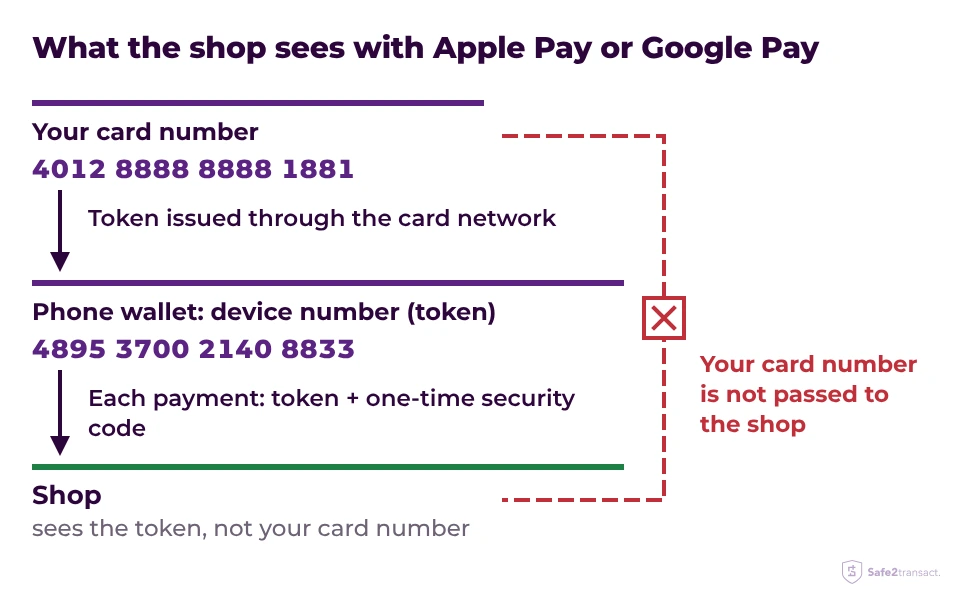
Often, yes: a virtual card is added to a phone wallet the same way as a plastic one, if the card issuer supports that wallet. Apple Pay and Google Pay don't pass your card number to the shop. The wallet stores a separate device number, a token issued through the card network, and every payment carries a one-time security code.
When do you need a physical card?
You need the physical card wherever a chip has to be read or a PIN typed in and your phone isn't an option.
- Cash machines. ATMs read the chip and ask for the PIN; only some accept a contactless phone.
- Deposits. Hotels and car-rental desks often ask to see the card at check-in, and some accept deposits only on a credit card.
- Travel. A second card is a backup if one is blocked or a terminal refuses it. Using a card abroad also brings currency conversion and ATM fees: see using your card abroad.
Commission Delegated Regulation (EU) 2018/389, Article 11, lets card providers skip strong customer authentication for contactless payments with the plastic card of up to €50, until the contactless payments since the last check pass €150 in total or five in a row; the terminal then asks for the PIN. Providers may set lower limits.
Which card should you choose?
Choose by what you pay for; most people end up with both.
At Safe2transact you hold one virtual and one physical Visa card at the same time. Both spend from one card balance, which you top up from your IBAN account instantly and without a fee. To get either, see how to order a Visa card.
What should you do if your card is lost or stolen?
Freeze the card first, then check what happened; if the card turns up, unfreezing it takes a tap.
Freeze the card
Open your provider's app and freeze the card. New payments are declined straight away, online, in shops and contactless.
Check your transactions
Look for payments you don't recognise and note the merchant, the amount and the date.
Contact your card provider
Report the card as lost or stolen and any payments you didn't make, so the provider blocks the card for good and opens a dispute where needed.
Replace the card
Order a new card. A virtual card keeps working for online payments while the replacement plastic card is on its way.
Safe2transact customers find the full steps in what to do if your card is lost or stolen. A blocked card can't be reactivated, so only block it permanently once you are sure it is gone.
Frequently asked questions
Do a virtual and a physical card have the same card number?
No, not even when both draw on the same balance. A subscription paid with the virtual card has to be moved by hand if you want it on the plastic card.
Does a virtual card expire?
Yes. A virtual card has an expiry date like a plastic card, and a merchant that stores it needs the new details once the card is replaced.
Is a virtual card a credit card?
Not necessarily. A virtual card is a format, not a type of credit: it is debit, credit or prepaid depending on the account behind it. Debit spends money already in the account, credit spends borrowed money, prepaid spends a balance loaded in advance.
IBAN and Visa card issuance and payment services are provided by Stanhope Financial UAB, a company registered in Lithuania (a member state of the European Union) with company code 305574870 and a registered address at Konstitucijos pr. 7, Vilnius, Lithuania. Stanhope Financial UAB is an Electronic Money Institution (EMI licence No. 78) authorized and regulated by the Bank of Lithuania. Access to your IBAN account and your VISA card is technically provided through the Safe2transact platform.