What is 3-D Secure (Visa Secure)?
3-D Secure is the check your card issuer runs when you pay online with a card: you approve the payment in an app or with a one-time code. EU payment law requires it for most online card payments; Visa calls its version Visa Secure.
3-D Secure is the security step in an online card payment where the company that issued your card asks you to confirm that the payment is yours. It is how payment cards meet the EU's rule on strong customer authentication online, and with most cards the confirmation is a tap in an app or a one-time code.
What is 3-D Secure?
3-D Secure is a protocol that lets your card issuer check who is paying before an online card payment is authorised. The name is also written 3D Secure or 3DS.
The "three domains" in the name are the shop's side, the card network in the middle and the issuer's side. Visa describes Visa Secure as "a programme that helps confirm your identity when you make an online purchase". The current version, EMV 3-D Secure 2, replaced the first version, which Visa switched off in October 2022.
Why does your card ask you to approve online payments?
Your card asks because EU law requires it: the second Payment Services Directive (PSD2), Article 97, obliges the payer's provider to apply strong customer authentication when you start an electronic payment. For online card payments, 3-D Secure is the channel that carries it.
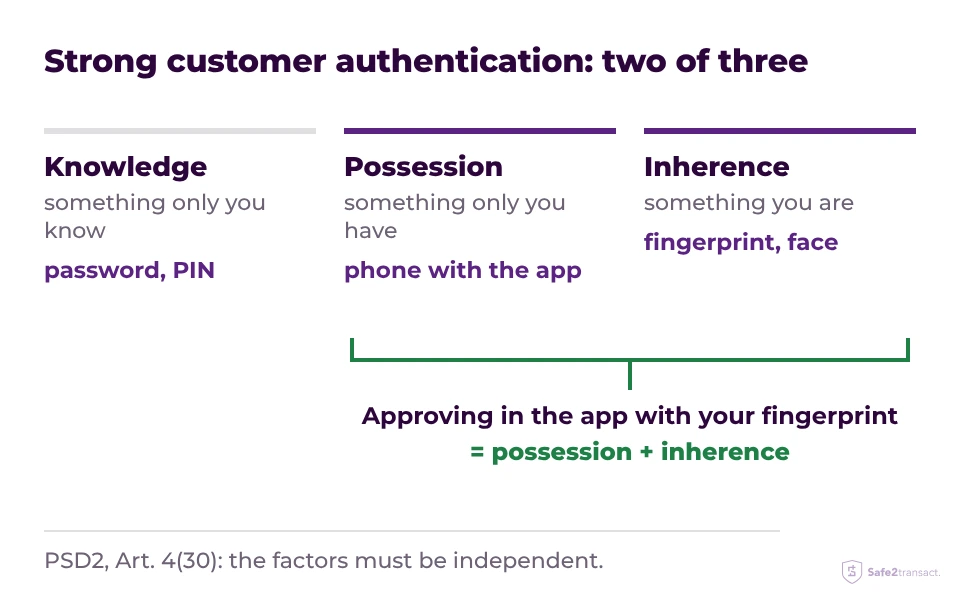
PSD2, Article 4(30), defines strong customer authentication as authentication "based on the use of two or more elements categorised as knowledge (something only the user knows), possession (something only the user possesses) and inherence (something the user is)". The elements must be independent, so that a breach of one does not compromise the others.
The rule works. The European Banking Authority and the European Central Bank reported in December 2025 that payments verified with strong customer authentication were less prone to fraud, especially card payments, and that card payment fraud was 17 times higher when the shop was outside the EEA, where the check is not legally required.
How does a 3-D Secure check work?
A 3-D Secure check runs between the moment you press "Pay" and the moment the shop sends the payment for authorisation, and it usually takes seconds.
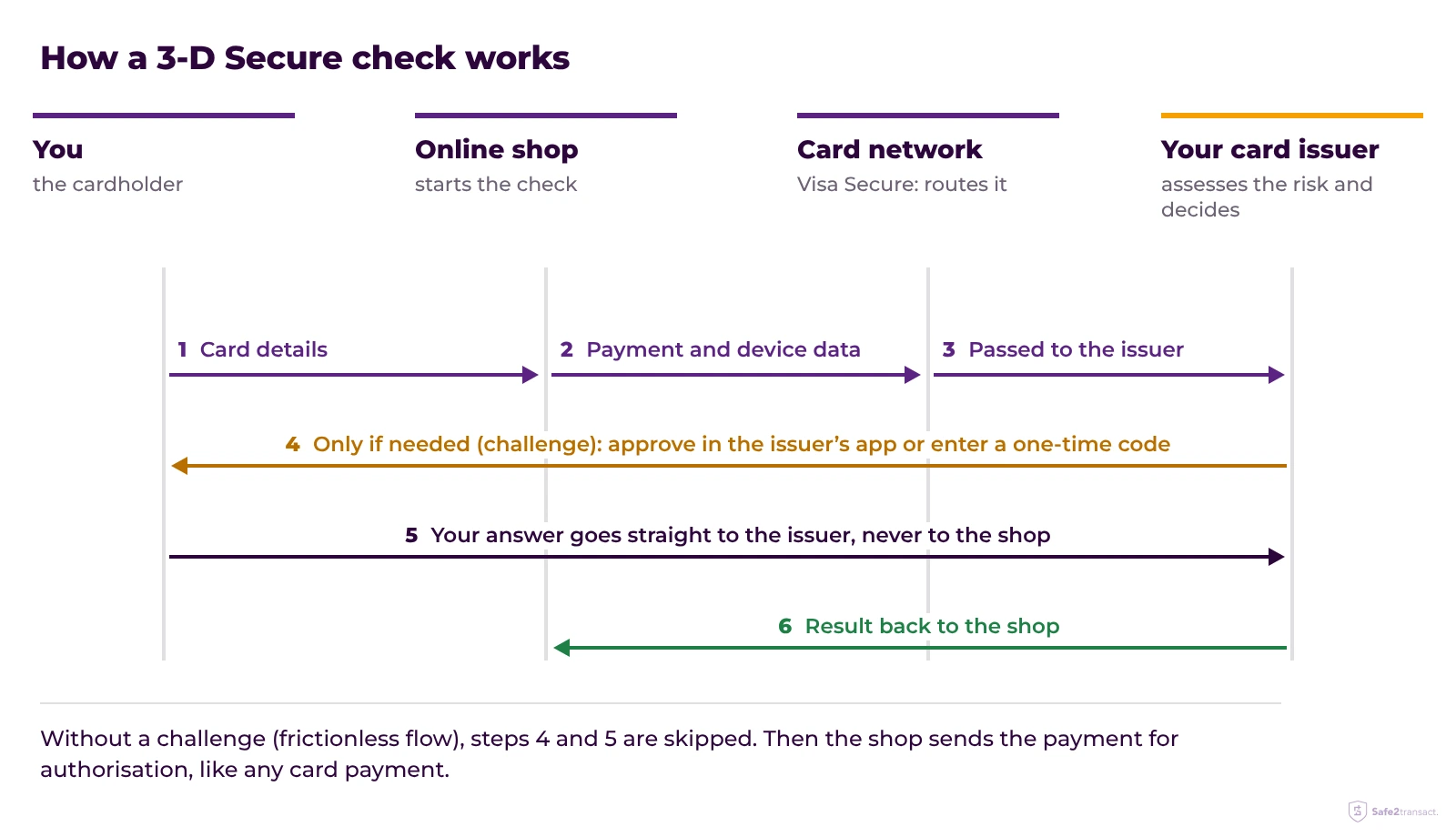
The EMV 3-D Secure specification defines over a hundred data elements the shop can send: the amount, the shop, the delivery address, the device and browser. The more the issuer receives, the more payments it can approve without asking you.
Frictionless or challenge?
The issuer chooses one of two paths. In the frictionless flow it approves the payment on the data alone, and you see no extra screen. In the challenge flow it asks you to confirm, because the payment looks risky or because the law requires authentication and no exemption applies.
App approval or one-time code?
The challenge is whatever your card issuer uses: a notification that opens its app, where you approve with your fingerprint, face or app PIN, or a one-time code sent to your phone or shown in an authenticator app. Visa puts it this way: the issuer "has a number of tools that can help verify your identity such as a one-time passcode or biometrics".
At Safe2transact, a card payment that needs your approval opens as a window in the web app with the amount, the merchant and the time, and you approve or reject it with the code from your authenticator app.
Who runs the check: the shop or your card issuer?
Your card issuer runs it. The shop only starts the check and receives the result; it never sees your code, your fingerprint or your app. EMVCo describes the challenge flow as one that "requires the cardholder to provide additional information directly to the issuer".
That is why a genuine approval request always comes from your card provider's own app, its usual text messages or the page of its own check, never from a phone call, an email link or a chat with someone who says they work for the shop or for your bank.
Approve only a payment you are making right now, for the amount and the shop on your screen.
What exactly do you approve?
You approve one payment: this amount, to this shop. Commission Delegated Regulation (EU) 2018/389, Article 5, requires the authentication to be linked to the amount and the payee, shown to you before you confirm, and invalidated by any change to either. This is called dynamic linking.
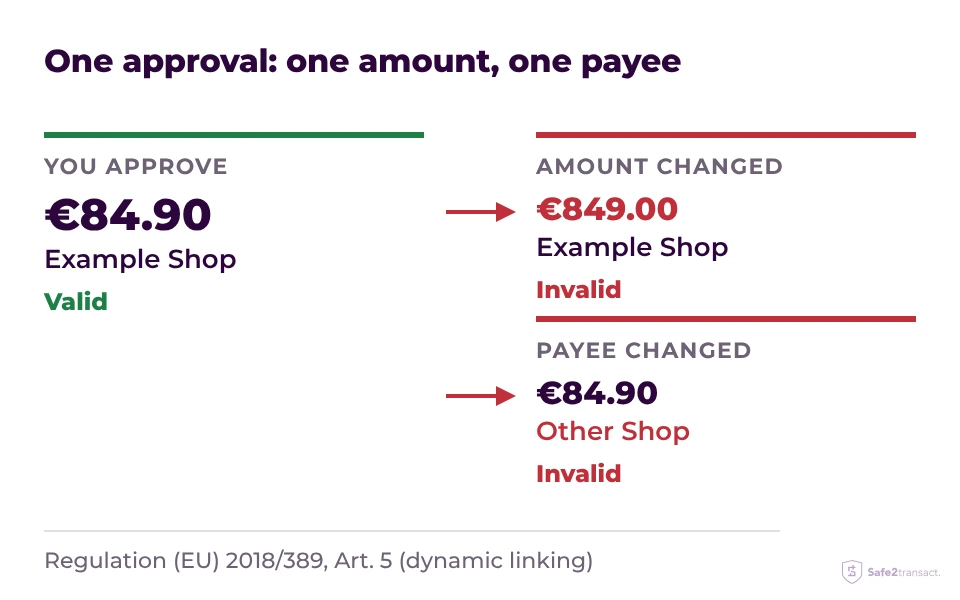
So read the screen before you confirm. A request for an amount you don't recognise, or for a shop you are not buying from, is not yours to approve. The same regulation limits failed attempts: after at most five wrong attempts in a row, the provider blocks authentication for a time or for good (Article 4(3)(b)).
When is 3-D Secure skipped?
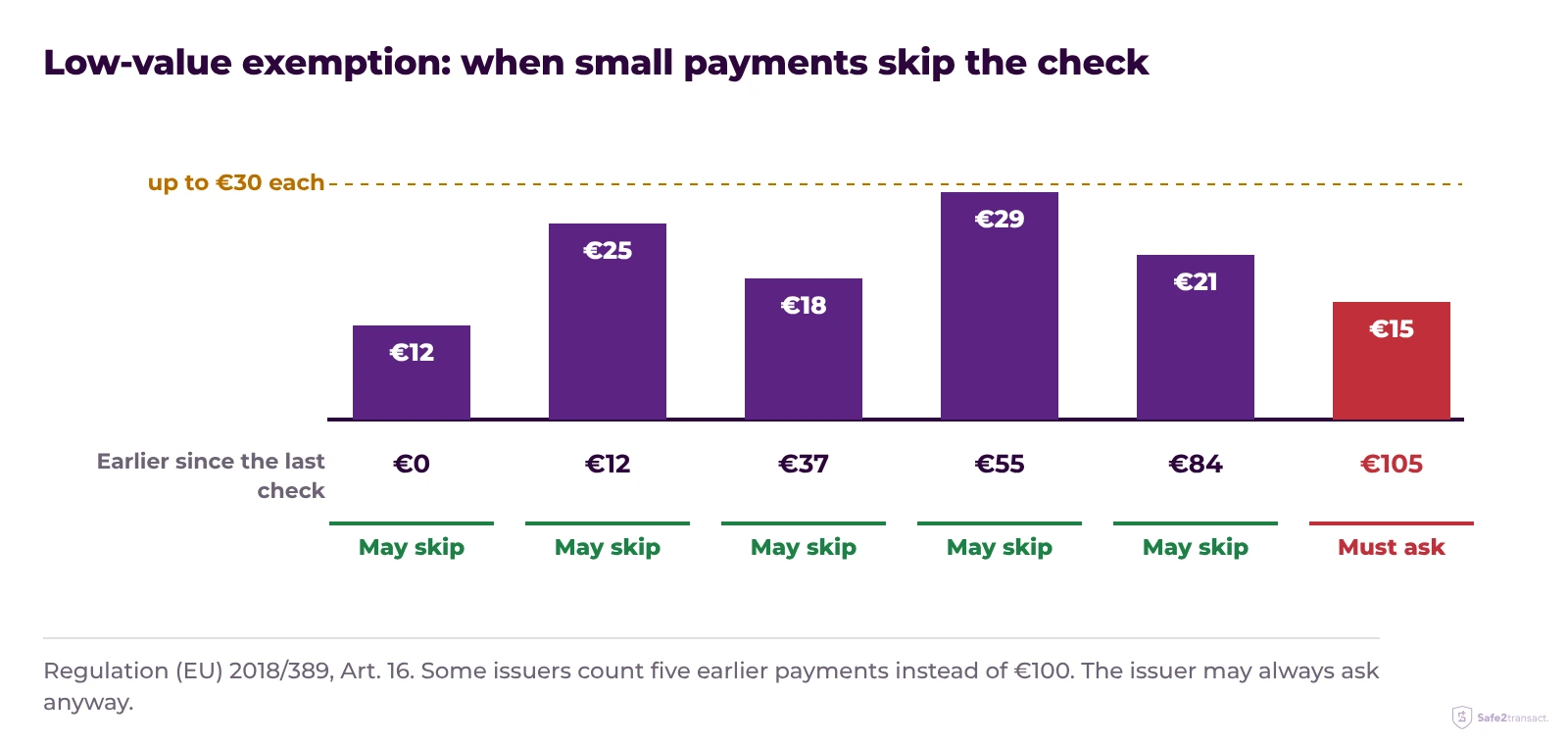
3-D Secure is skipped when the payment falls under an exemption in Commission Delegated Regulation (EU) 2018/389 or outside PSD2 altogether. The exemptions allow the provider not to ask; none of them forbids it.
| Situation | The rule |
|---|---|
| Low-value payment | Up to €30, while earlier payments since the last check stay within €100 in total, or within five payments (Article 16) |
| Trusted beneficiaries | A shop you put on your provider's list of trusted beneficiaries; creating or changing the list needs the check (Article 13) |
| Recurring payments | The same amount to the same shop after the first payment, which needs the check (Article 14) |
| Low-risk payments | The provider's real-time risk analysis, up to €100, €250 or €500 if its card fraud rate is at or below 0.13%, 0.06% or 0.01% (Article 18) |
| Payments the shop starts | Charges the shop makes on its own under a mandate you gave, such as a usage bill, are outside the rule (European Commission answer in EBA Q&A 2018_4031) |
| Shops outside the EEA | Not bound by the rule, so the check may not happen at all |
The provider decides, not the shop. For card payments the European Banking Authority states that the payer's provider, your card issuer, always has the final say on whether an exemption applies. A shop may ask for an exemption; your issuer may still ask you to approve, and that is not a fault.
What should you do if you get a request you did not expect?
Reject it. An approval request you did not start means someone has your card number, expiry date and security code and is trying to pay with them; your approval is the one thing they lack.
Reject the request
Tap reject or close the screen without entering the code. The payment fails, and nothing is taken from your account.
Freeze your card
Freeze the card in your provider's app so that no further payment attempts go through, online or in shops. Safe2transact customers do it in a few clicks: how to freeze or unfreeze your Visa card.
Check your recent transactions
Look for small payments you don't recognise: card details are often tested with a low-value payment first.
Tell your card provider
Report the attempt so your provider can replace the card and dispute any payment that went through.
Safe2transact customers report a fraud attempt from the app: see how to report suspicious activity. Try the situations below to see what the issuer asks and how to answer.
Frequently asked questions
Why did my payment fail at the 3-D Secure step?
The request expired, the code was wrong, or the approval window was closed before it finished. Try the payment again once; if it keeps failing, contact your card provider, because only the issuer can see why it declined.
Who pays if a payment went through without strong customer authentication?
Your provider, as a rule. PSD2, Article 74(2), says that where the payer's provider does not require strong customer authentication, the payer bears no financial loss unless the payer acted fraudulently.
Can I switch 3-D Secure off?
No. Strong customer authentication is required by law for most online card payments in the EEA, and only your card issuer decides when an exemption applies.
Does 3-D Secure apply when I pay in a shop?
No. In a shop, the chip and PIN already are strong customer authentication, and contactless payments of up to €50 may skip it within the limits explained in our guide to virtual and physical cards. 3-D Secure is for payments where the card is not present.
IBAN and Visa card issuance and payment services are provided by Stanhope Financial UAB, a company registered in Lithuania (a member state of the European Union) with company code 305574870 and a registered address at Konstitucijos pr. 7, Vilnius, Lithuania. Stanhope Financial UAB is an Electronic Money Institution (EMI licence No. 78) authorized and regulated by the Bank of Lithuania. Access to your IBAN account and your VISA card is technically provided through the Safe2transact platform.