Payment cards
Payment cards are debit, credit or prepaid cards that pay through a card network such as Visa; a debit card spends money you already have. These guides explain card types, what happens when you pay, and how card payments are protected.
A payment card pays through a card network such as Visa or Mastercard and comes as a debit, credit or prepaid card. All three look the same at the checkout; what differs is where the money comes from. A debit card pays with money that is already in the account behind it: the issuer checks the balance at the moment you pay and approves or declines the payment within seconds.
What is the difference between debit, credit and prepaid cards?
The difference is the source of the money: a debit card spends your own balance, a credit card spends borrowed money, a prepaid card spends a balance loaded in advance.
| Debit card | Credit card | Prepaid card | |
|---|---|---|---|
| Pays from | The account it is linked to | A credit line from the issuer | A balance loaded in advance |
| You pay later | No | Yes, by the statement date | No |
| Interest | None | On what you don't repay in full | None |
| Spending limit | Your balance and card limits | Your credit limit | The loaded balance |
EU law keeps the categories apart. The Interchange Fee Regulation (EU) 2015/751 requires card issuers to make each card identifiable as debit, credit, prepaid or commercial, so the merchant and you know which kind is used. Safe2transact calls its Visa card a debit card: it spends from a card balance you top up from your IBAN account, not from the IBAN account itself.
How does a card payment work?
A card payment is a message that travels from the shop to your card's issuer and back before the checkout finishes. Five parties take part: you as cardholder, the merchant, the merchant's payment provider (the acquirer), the card network, such as Visa or Mastercard, and the issuer that gave you the card.
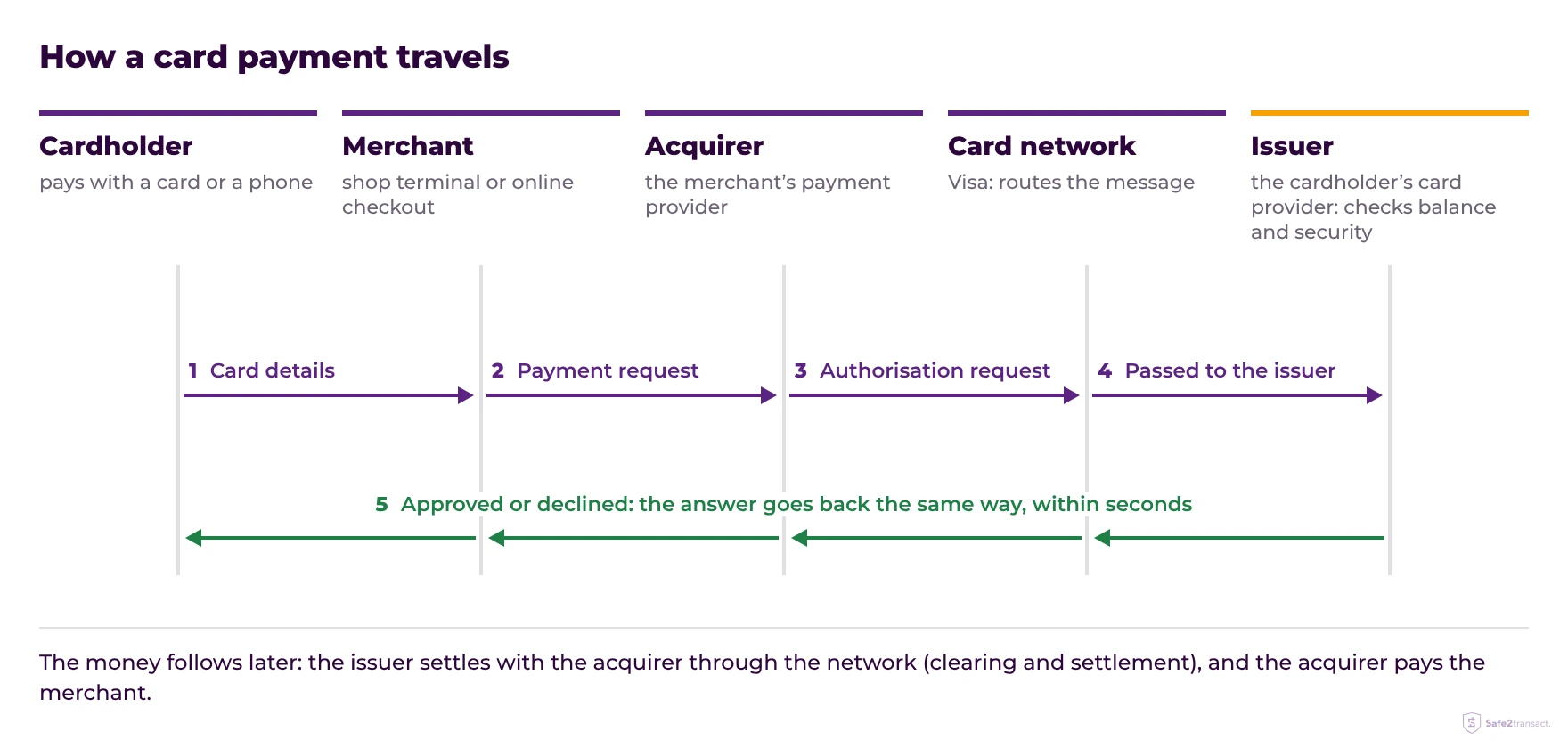
The first step is the authorisation: the issuer checks the card, the balance and the security data, then approves or declines. The money moves later, in clearing and settlement, when the issuer pays the acquirer through the network and the acquirer pays the merchant. A payment that shows as pending in your app is authorised but not yet settled. Abroad, the terminal may offer to charge you in euros instead of the local currency; the guide to paying in local currency or euros explains who converts the price and what it costs.
Should you use a virtual or a physical card?
Most people use both: a virtual card for online payments and a physical card for shops, cash machines and travel. A virtual card has a card number, expiry date and security code but no plastic, while a physical card adds the chip and PIN that terminals need. The guide to virtual and physical cards compares them, explains which is safer online and lets you work out which one fits what you pay for.
How are card payments protected?
Card payments are protected in layers, from the chip in the card to a check by the issuer on every payment.
- Chip and PIN. Each chip payment carries a one-time cryptogram, so a copied magnetic stripe is useless at a chip terminal.
- Strong customer authentication. The second Payment Services Directive (PSD2) requires two of three factors (something you know, have or are) for most online card payments. Card schemes deliver it through EMV 3-D Secure, which Visa calls Visa Secure.
- Contactless limits. Commission Delegated Regulation (EU) 2018/389 lets card providers skip that check for contactless payments of up to €50, until €150 in total or five payments in a row since the last check.
- Tokens in phone wallets. Apple Pay and Google Pay pay with a device-specific number instead of the card number.
The fastest protection is still your own: freeze the card in your provider's app the moment it goes missing. When a payment goes wrong or was never yours, the guide to disputing a card payment shows the way back to your money. Safe2transact customers find the steps in what to do if your card is lost or stolen, and the Safe2transact Visa card page shows what the card offers.
- Virtual card vs physical card: what’s the difference?A virtual card is a payment card that exists only as card details in an app, made for online payments; a physical card adds a chip and PIN for shops and cash machines. Most people use both.
- What is 3-D Secure (Visa Secure)?3-D Secure is the check your card issuer runs when you pay online with a card: you approve the payment in an app or with a one-time code. EU payment law requires it for most online card payments; Visa calls its version Visa Secure.
- Paying by card abroad: local currency or euros?Pay in the local currency. When a terminal, cash machine or checkout abroad offers to charge your card in euros, that is dynamic currency conversion (DCC): the shop's side converts at its own rate and adds a mark-up, which usually costs more than your card's own conversion.
- What is a chargeback, and how do you dispute a card payment?A chargeback is the reversal of a card payment that your card issuer raises against the merchant under the card scheme's rules, for a payment you made that went wrong. A payment you never made is refunded under EU law instead, by the end of the next business day after you report it.