SEPA transfers explained: how long they take and what they cost
A SEPA transfer is a euro payment from one IBAN to another anywhere in the Single Euro Payments Area. A standard SEPA Credit Transfer reaches the payee's provider by the end of the next business day at the latest; SEPA Instant takes 10 seconds, on any day.
What is a SEPA transfer?
A SEPA transfer is a payment in euros from one IBAN to another anywhere in the Single Euro Payments Area, made under the same rules in every country. It's the backbone of euro payments: a transfer from Vilnius to Lisbon works exactly like one inside Vilnius.
Which countries are in SEPA?
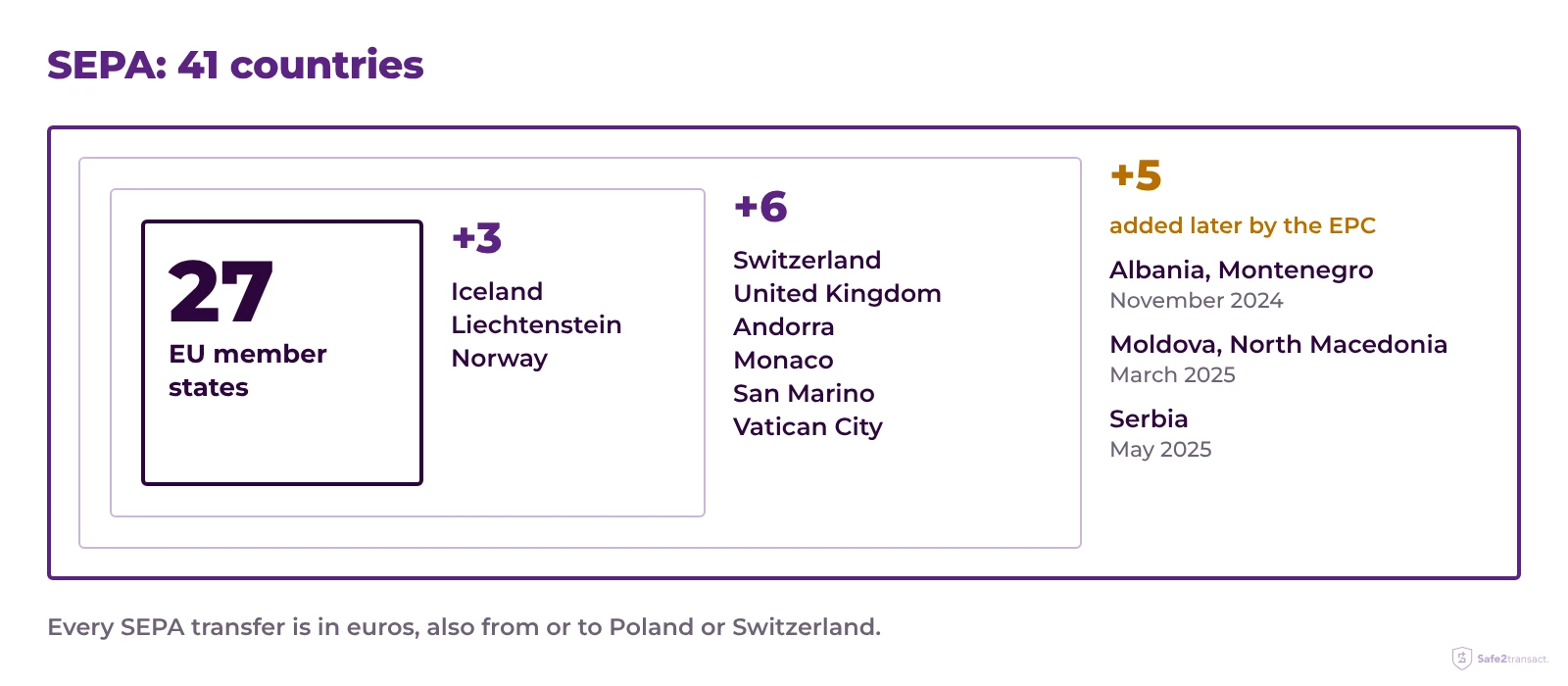
SEPA covers 41 countries: the 27 EU member states, Iceland, Liechtenstein and Norway, Switzerland, the United Kingdom, Andorra, Monaco, San Marino and Vatican City, plus five countries the EPC has since added to the schemes' geographical scope: Albania and Montenegro (November 2024), Moldova and North Macedonia (March 2025) and Serbia (May 2025). Providers join the schemes one by one, so the EPC's register of participants, not the country list, shows whether a provider can be reached.
SEPA is about the currency, not the country: every SEPA transfer is in euros, also from or to Poland or Switzerland, and a payment in złoty or Swiss francs is not a SEPA payment.
What types of SEPA payments are there?
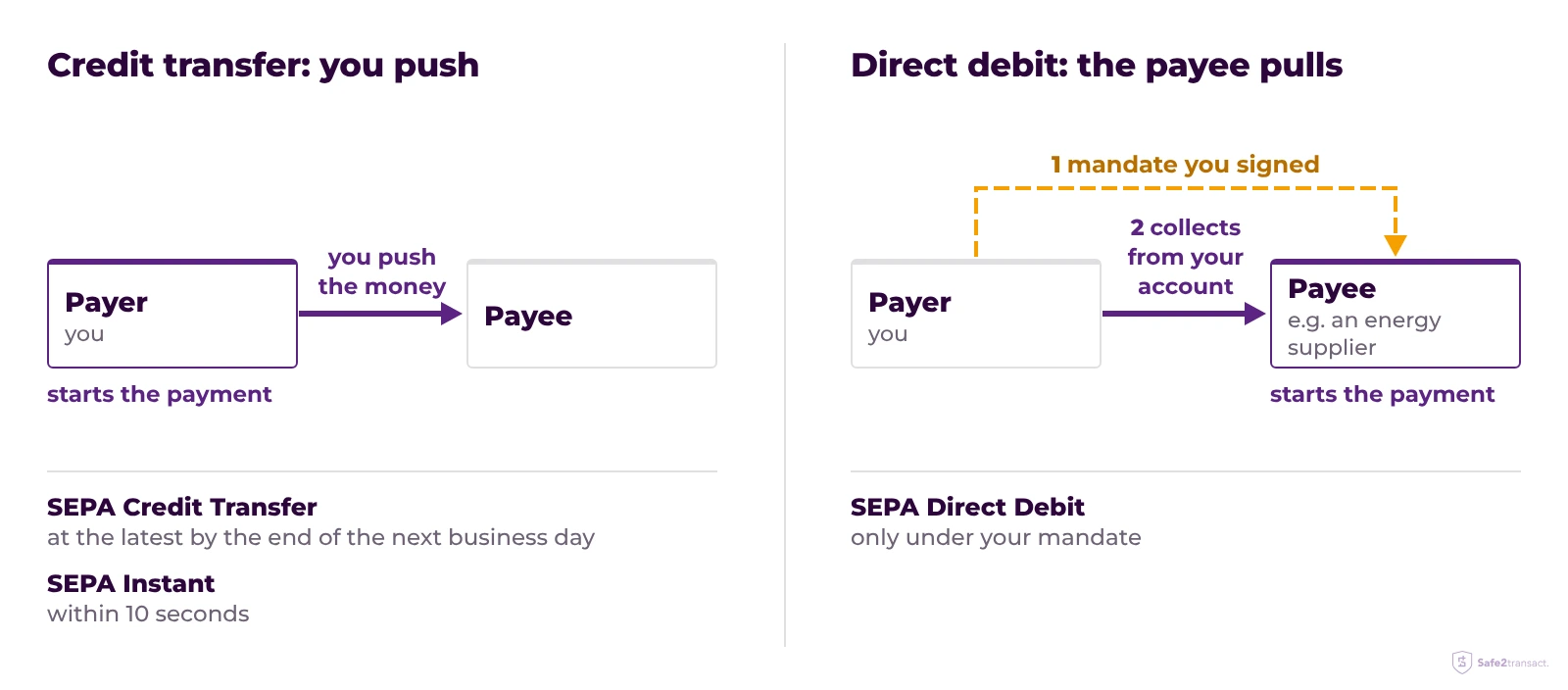
The EPC runs three payment schemes: SEPA Credit Transfer (SCT), SEPA Instant Credit Transfer (SCT Inst) and SEPA Direct Debit (SDD). The first two are credit transfers: you push the money to the payee. With a direct debit the payee pulls it: a company such as an energy supplier collects from your account under a mandate you signed. The two transfers carry the same data to the same accounts but differ in speed, running days and whether you can stop them.
| SEPA Credit Transfer | SEPA Instant | |
|---|---|---|
| Money arrives | At the latest by the end of the next business day | Within 10 seconds |
| Runs on | Business days | Every day, 24 hours a day |
| Maximum amount | Set by your provider | No scheme maximum since 2025; your provider and you can set limits |
| Price | Same as a domestic transfer (within the EU) | Not more than a standard transfer from the same provider |
| Stop it after sending | Only a future-dated transfer, until the end of the business day before | No: it's final within seconds |
| Main rule | PSD2, Art. 83 | Instant Payments Regulation (EU) 2024/886 |
SEPA Instant is becoming the default. Under the Instant Payments Regulation, every euro-area provider that offers euro transfers has had to receive instant transfers since 9 January 2025 and send them since 9 October 2025. Payment and electronic money institutions, the licences most fintech apps run on, have until 9 April 2027, and providers in EU countries outside the euro area until 2027 as well (European Central Bank timetable); until then, whether you can send one depends on your provider.
How does a SEPA transfer travel?
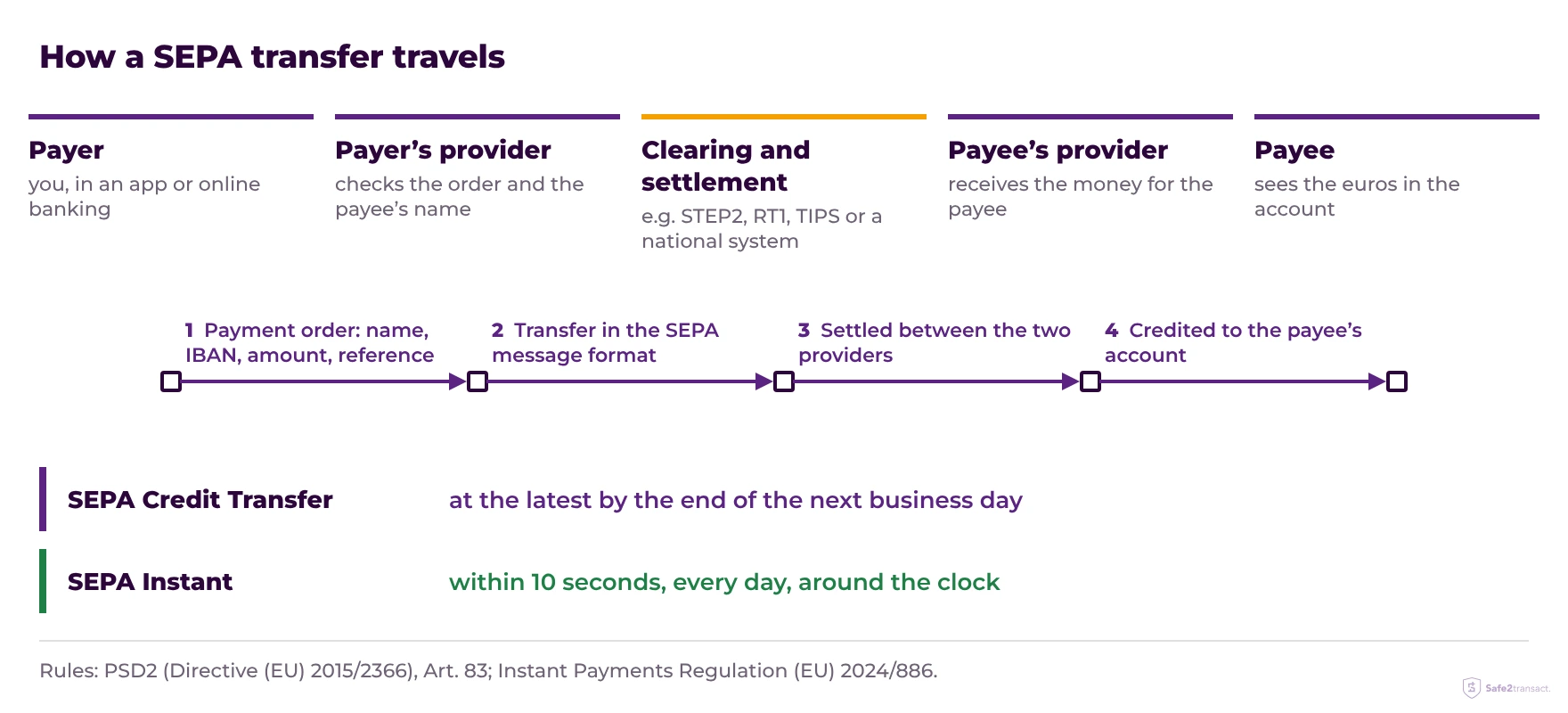
A SEPA transfer passes through three parties between you and the payee: your payment provider, a clearing and settlement system and the payee's provider.
You give the payment order
You enter the payee's name, IBAN, amount and reference. Your provider checks the name against the IBAN, and you confirm with strong customer authentication: a code, a fingerprint or an approval in the app.
Your provider checks and sends it
Your provider checks your balance, screens the payment for fraud and sanctions, debits your account and sends a standard SEPA message (ISO 20022 XML).
The clearing system settles it
A clearing and settlement system passes the transfer on and settles the money between the two providers: EBA CLEARING's STEP2 for standard transfers, the Eurosystem's TIPS and EBA CLEARING's RT1 for instant ones, or a national system.
The payee's provider credits the account
The payee's provider must put the amount at the payee's disposal immediately (PSD2, Art. 87).
The payee sees the money
The payment appears with your name and reference, which is how invoices get matched to payments.
How long does a SEPA transfer take?
A standard SEPA Credit Transfer reaches the payee's provider at the latest by the end of the next business day after your provider receives the order (PSD2, Art. 83); SEPA Instant takes at most 10 seconds, at any hour of any day. Three things decide the latest date of a standard transfer:
- Business days. Interbank SEPA settlement runs on TARGET business days: Monday to Friday, except New Year's Day, Good Friday, Easter Monday, 1 May, 25 and 26 December. A provider closed on a national holiday can add a day.
- The cut-off time. An order sent after the provider's cut-off, near the end of its business day, counts as received on the next business day (PSD2, Art. 78).
- The day you send it. An order sent on a Saturday counts as received on Monday, so it may arrive as late as Tuesday evening.
The law sets the latest moment, not the usual one: many standard transfers arrive the same day, while one ordered on paper may take a business day more.
What do you need to send a SEPA transfer?
You need four details: the payee's name, the payee's IBAN, the amount in euros and a reference.
- Payee's name: the account holder's name, a person or a business, as it appears on the account.
- IBAN: the payee's account number, up to 34 characters, whose two check digits catch most typing errors.
- Amount: always in euros.
- Reference: free text, such as an invoice number, so the payee knows what the money is for.
You don't need a BIC: the SEPA Regulation has forbidden providers to ask for it since 1 February 2014 for domestic payments and since 1 February 2016 for payments to other countries (Art. 5(7)), so you can leave a BIC field empty. In the Safe2transact app, making a payment takes exactly these details.
How much does a SEPA transfer cost?
Within the EU, a euro transfer to another country costs the same as a domestic transfer of the same value with the same provider (Regulation (EU) 2021/1230, Art. 3): a domestic euro transfer in the euro area, a domestic transfer in złoty in Poland. The rule compares prices; it doesn't make transfers free, and some providers charge a flat fee for both.
Inside the EU, sending euros to another country costs the same as sending them down the street.
Three more rules keep the price clear:
- SEPA Instant may not cost more than a standard transfer from the same provider, and the payee name check is free (Instant Payments Regulation, Art. 5b).
- Nothing is taken off on the way. Each side pays its own provider, and the full amount is transferred; only the payee's own provider may deduct its fee, if the payee agreed (PSD2, Art. 81).
- Outside the EU, for example to the United Kingdom or Switzerland, the equal-price rule doesn't apply.
What is Verification of Payee?
Verification of Payee is a free check before you confirm a SEPA transfer, standard or instant: your provider asks the payee's provider whether the name you entered belongs to the IBAN and shows you a match, a close match, a no match or that verification wasn't possible. It's required in the euro area since 9 October 2025 and in the other EU countries from 9 July 2027. The guide to what Verification of Payee is and what each result means covers the four results, who is liable if you pay after a warning and what the check doesn't catch.
Safe2transact runs the check before every SEPA payment; Help explains what each payee name check result means.
Are there limits on SEPA transfers?
The SEPA schemes set no maximum: since the 2025 rulebook, SEPA Instant has none at scheme level, where it used to be €100,000. Limits come from elsewhere:
- Your provider sets limits per transfer, day or month, depending on the account and its risk checks.
- You can set your own limit on instant transfers, per day or per transaction (Instant Payments Regulation, Art. 5a).
- The message format limits the reference to 140 characters and the payee's name to 70.
What if a SEPA transfer goes wrong?
Act straight away: what you can recover depends on what went wrong and how fast your provider can reach the payee's provider.
- You typed a wrong IBAN. A transfer to the IBAN you entered counts as correctly executed, so your provider isn't liable. It must still make reasonable efforts to recover the money, with the payee's provider's cooperation, and if that fails give you, on written request, the information to claim it yourself (PSD2, Art. 88).
- A payment you didn't authorise, or one executed wrongly. Tell your provider without delay, at the latest 13 months after the debit (PSD2, Art. 71). An unauthorised payment must be refunded by the end of the next business day, unless the provider suspects fraud and reports it (Art. 73).
- A direct debit you want back. A SEPA Core Direct Debit you authorised can be refunded on request within eight weeks, without a reason (PSD2, Art. 76 and 77; SDD Core rulebook).
Frequently asked questions
Can I cancel a SEPA transfer after sending it?
Usually not: once your provider has received the order, you can't revoke it (PSD2, Art. 80), except a future-dated transfer until the end of the business day before. For a transfer already sent, your provider can ask the payee's provider to return it, but the payee has to agree.
Is a SEPA transfer the same as a SWIFT transfer?
No. A SEPA transfer is always in euros, stays inside SEPA and follows one set of rules on time and price. A SWIFT transfer can be in many currencies and reach almost any country, often through correspondent banks that can each take a fee.
Why did my transfer take longer than one business day?
Besides the cut-off time, weekends and holidays, an extra fraud or compliance check can hold a payment. Ask your provider for the date it received the order: the deadline runs from that day.
IBAN and Visa card issuance and payment services are provided by Stanhope Financial UAB, a company registered in Lithuania (a member state of the European Union) with company code 305574870 and a registered address at Konstitucijos pr. 7, Vilnius, Lithuania. Stanhope Financial UAB is an Electronic Money Institution (EMI licence No. 78) authorized and regulated by the Bank of Lithuania. Access to your IBAN account and your VISA card is technically provided through the Safe2transact platform.