What is Verification of Payee?
Verification of Payee (VoP) is the free check that compares the payee's name you entered with the name on the account behind the IBAN, before you confirm a euro transfer. Your provider shows one of four results: match, close match, no match or verification not possible.
What is Verification of Payee?
Verification of Payee (VoP) is a check your payment provider must run before you authorise a euro credit transfer: it asks the payee's provider whether the name you entered belongs to the IBAN you entered, and shows you the answer. The obligation sits in Article 5c of the SEPA Regulation (EU) No 260/2012, added by the Instant Payments Regulation (EU) 2024/886, and covers standard and instant transfers alike. Among the safeguards of euro payments, it's the one that looks past the number to the person.
Before VoP, nobody compared the name on a payment order with the account. The two check digits of an IBAN catch typing errors, but a valid IBAN that belongs to someone else passes them, and a transfer executed to the IBAN you gave counts as correctly executed, whatever name you typed (PSD2, Art. 88).
How does Verification of Payee work?
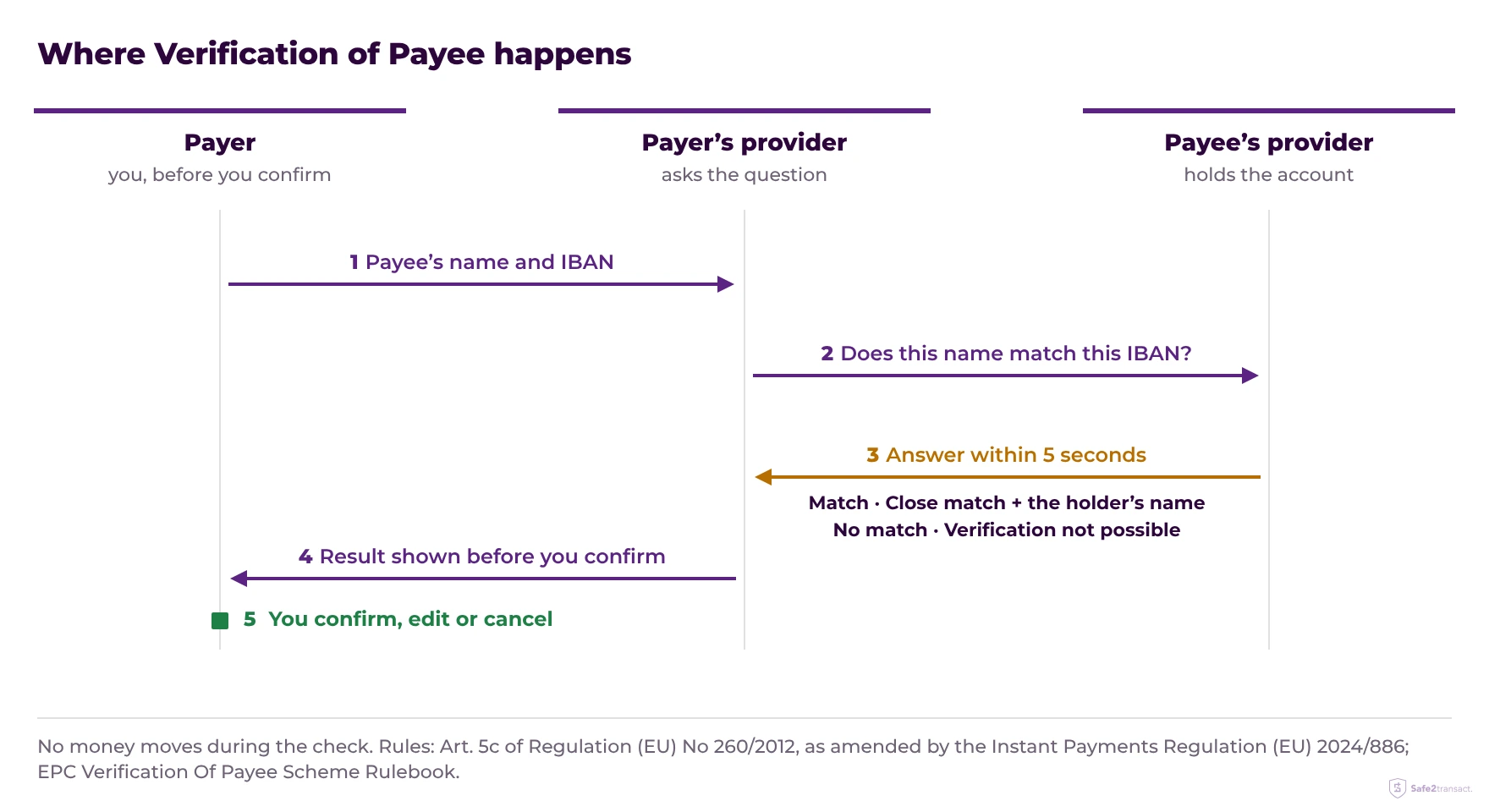
Verification of Payee is a question and an answer between two providers, asked in the seconds after you enter the payee's details and before you're offered the button to confirm.
You enter the payee's name and IBAN
For a person, the name is the first name and surname; for a business, its commercial or legal name (Regulation (EU) No 260/2012, Art. 2(1d)).
Your provider sends a request
It checks that the IBAN is well-formed and sends one VoP request per IBAN to the payee's provider.
The payee's provider compares
It compares the name with its records for that account and answers with one of four results. On a close match it adds the account holder's name.
You see the answer
The EPC rulebook allows at most 5 seconds from request to answer, preferably 1 second or less, every day around the clock. No answer within 5 seconds counts as "verification not possible".
You decide
You confirm, correct the details or cancel. No money moves until you authorise the transfer.
Every transfer gets its own check, including payees you've paid many times: the European Commission's questions and answers on the Instant Payments Regulation state that the payer's provider must ensure the verification "for every credit transfer". Two exceptions exist. A paper payment order handed in while you aren't present isn't checked, and a business sending a batch of payments may opt out and opt back in at any time (Art. 5c(4) and (6)). Consumers can't opt out.
What do the four results mean?
The EPC Verification Of Payee rulebook defines four results: Match, Close Match with the name of the account holder, No Match and Verification check not possible. Your provider must pass on any result other than a match straight away, as the payee's provider gave it.
| Result | What your provider shows | What to do |
|---|---|---|
| Match | The name and the IBAN belong together | Confirm, if the payment itself is one you expect |
| Close match | The account holder's name as the payee's provider has it, such as "Anna Kowalska" when you typed "Anna Kowalksa" | Use that name if it's the person or business you mean; stop if you don't recognise it |
| No match | A warning that the money may go to an account not held by the payee you named | Check the IBAN and name with the payee through a contact you already trust |
| Verification not possible | The check couldn't be done, with the same warning | Check the details yourself; retry if your provider offers it |
A close match has no formula in the regulation: the EPC's matching recommendations guide when a small difference, such as a typo or a missing middle name, counts as almost a match. For businesses, you may enter either the commercial name or the legal name. The European Commission expects providers to check both, which means collecting their customers' trading names; a trading name the payee's provider hasn't recorded can come back as no match.
On a close match, the payee's provider returns only the name of the account holder you were trying to pay and never discloses other holders of a joint account (EPC rulebook, section 3.2). A no match returns no name at all.
Can you still pay after a warning?
Yes. Verification of Payee informs; it never blocks: the regulation says the service "does not prevent payers from authorising the credit transfer concerned" (Art. 5c(5)). When you go ahead after a close match, a no match or a verification not possible, your provider must tell you what ignoring the notification means for its liability and for your right to a refund (Art. 5c(7)).
Verification of Payee warns but never decides: after a warning, the choice to pay and the risk of paying the wrong account are yours.
Who is liable if the money goes to the wrong account?
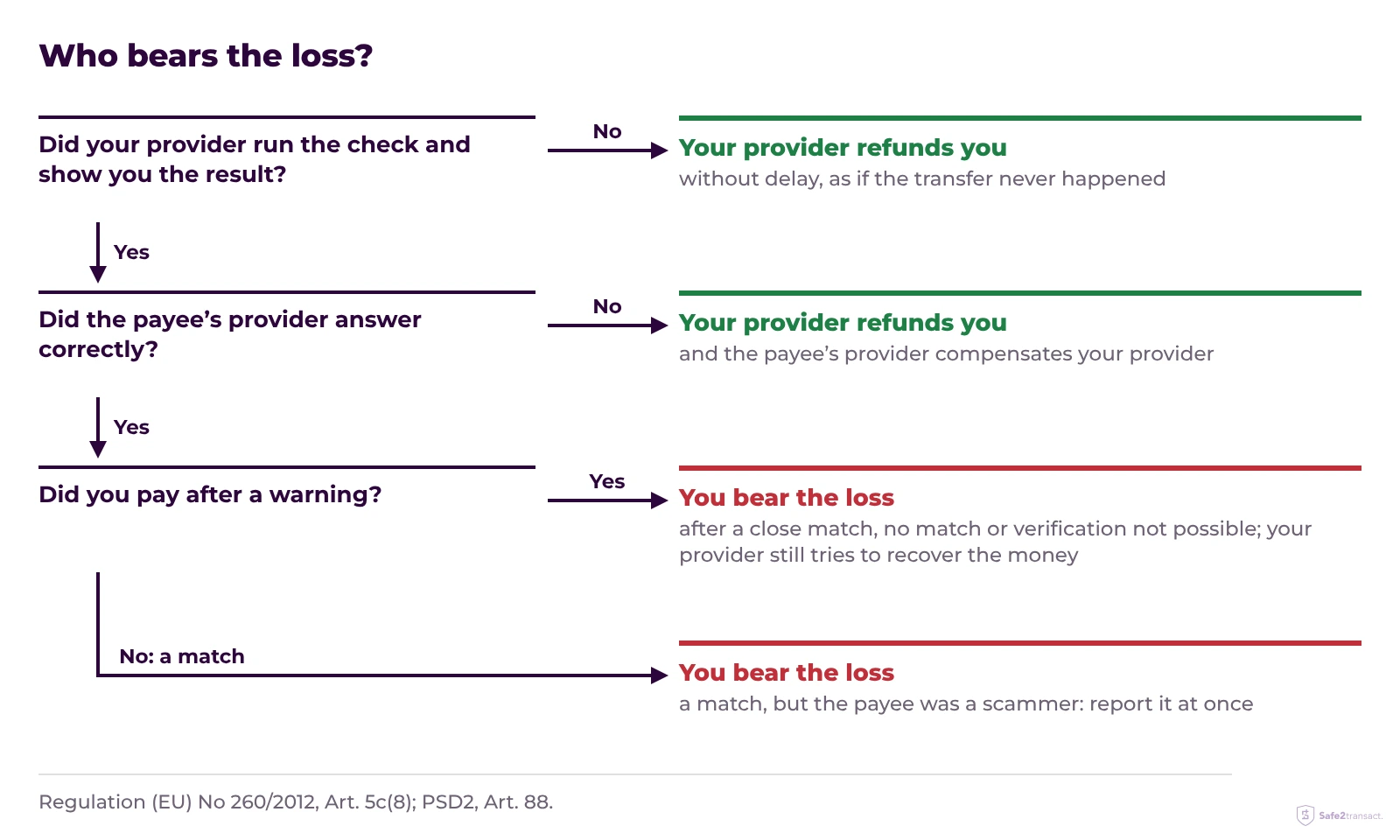
The answer depends on whether the providers did their part. A provider that ran the check and showed you the result isn't liable for a transfer to an unintended payee (Art. 5c(8)); a provider that failed to run the check or to warn you must refund you.
| What happened | Who bears the loss |
|---|---|
| You paid after a close match, no match or verification not possible | You. Your provider complied, so it isn't liable; it still makes reasonable efforts to recover the money (PSD2, Art. 88) |
| Your provider skipped the check or didn't show you the warning | Your provider. It refunds you without delay and restores your account as if the transfer never happened (Art. 5c(8)) |
| The payee's provider answered wrongly | Your provider refunds you, and the payee's provider compensates your provider (Art. 5c(8)) |
| You got a match, but the payee was a scammer | You, as with any payment you authorised; report it at once |
Any further loss caused by your provider's failure, beyond the refund, may be compensated under the law that governs your contract with it (Art. 5c(8)).
What does Verification of Payee not catch?
Verification of Payee checks a name against an account; it says nothing about whether the person or business behind that account is genuine. A scammer who asks you to pay into an account in their own name gets a match.
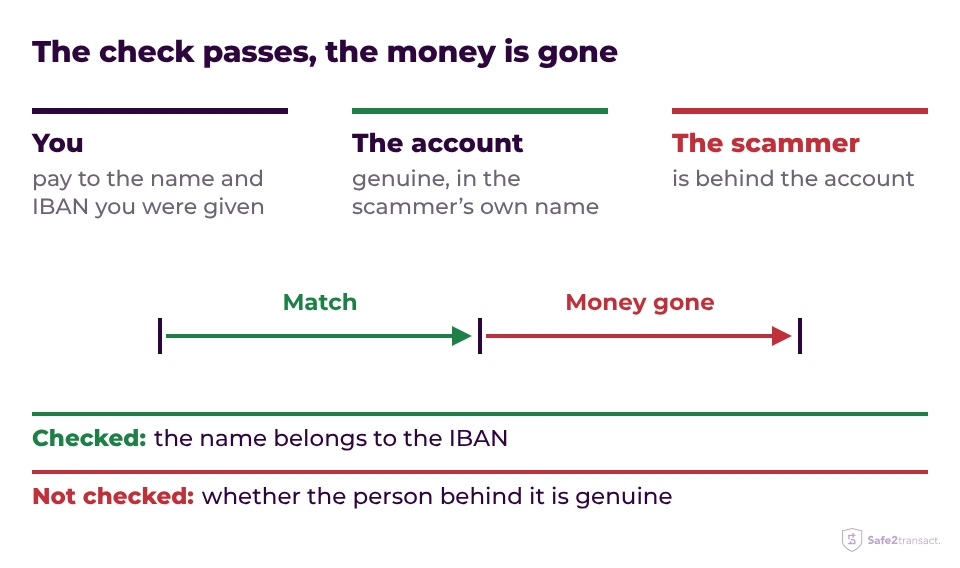
- "Safe account" calls. A caller posing as your bank or the police gives you an IBAN and a name, both real and both theirs: match.
- Investment, romance and fake-shop scams. The account is genuine and in the name you were given: match.
- Invoice fraud. "New bank details" for a supplier lead to a fraudster's account in a similar name: a close match or no match is your cue to call the supplier.
When did Verification of Payee become mandatory?
Verification of Payee has been mandatory for providers in euro-area countries since 9 October 2025, and becomes mandatory for providers in EU countries outside the euro area, such as Poland, on 9 July 2027 (Art. 5c(9)). The EPC scheme rulebook took effect four days earlier, on 5 October 2025.
- Every provider type. The duty applies to banks, payment institutions and electronic money institutions alike whenever the payer is their customer (European Commission Q&A).
- Euro transfers only. It covers credit transfers in euro, standard and instant; a transfer in złoty inside Poland is outside it.
- Free. Providers may not charge for it (Art. 5b(2)), and the European Central Bank states that the service is offered free of charge to the payer.
The same regulation is moving SEPA transfers to instant: euro-area banks have had to send instant transfers since that same 9 October 2025. The name check comes with every transfer, whether the money arrives in 10 seconds or by the end of the next business day.
How does Safe2transact show the payee name check?
Safe2transact runs the check before you confirm a SEPA payment, in the app and on the web, and shows the result above the Confirm button. On a close match, "Use this name" swaps your typed name for the account holder's; after a no match or verification not possible, you can still confirm, at your own risk. Help explains what each payee name check result means and what to do next.
Frequently asked questions
What name should I enter for a joint account?
The first name and surname of at least one of the account holders (EPC rulebook, section 3.2). The payee's provider compares your name with that holder and never tells you the names of the others.
Can someone use Verification of Payee to find out who owns an IBAN?
Not as intended. Providers may use the scheme only for real payments, a close match returns a name only when the typed name is almost right, and a no match returns nothing.
Does Verification of Payee apply to transfers to the United Kingdom or Switzerland?
No. Both are in SEPA but outside the European Economic Area, and the European Commission has confirmed that transfers there are outside the regulation.
What happens if the check takes too long?
After 5 seconds without an answer, your provider must tell you that verification wasn't possible, with the usual warning, and may let you retry (EPC rulebook, section 3.3.2).
IBAN and Visa card issuance and payment services are provided by Stanhope Financial UAB, a company registered in Lithuania (a member state of the European Union) with company code 305574870 and a registered address at Konstitucijos pr. 7, Vilnius, Lithuania. Stanhope Financial UAB is an Electronic Money Institution (EMI licence No. 78) authorized and regulated by the Bank of Lithuania. Access to your IBAN account and your VISA card is technically provided through the Safe2transact platform.