Paying by card abroad: local currency or euros?
Pay in the local currency. When a terminal, cash machine or checkout abroad offers to charge your card in euros, that is dynamic currency conversion (DCC): the shop's side converts at its own rate and adds a mark-up, which usually costs more than your card's own conversion.
Paying in local currency or in euros is a choice about who converts the price: answer "local currency" and your card's side converts it, answer "euros" and the shop's side converts it, at a rate it picks itself.
Should you pay in local currency or in euros?
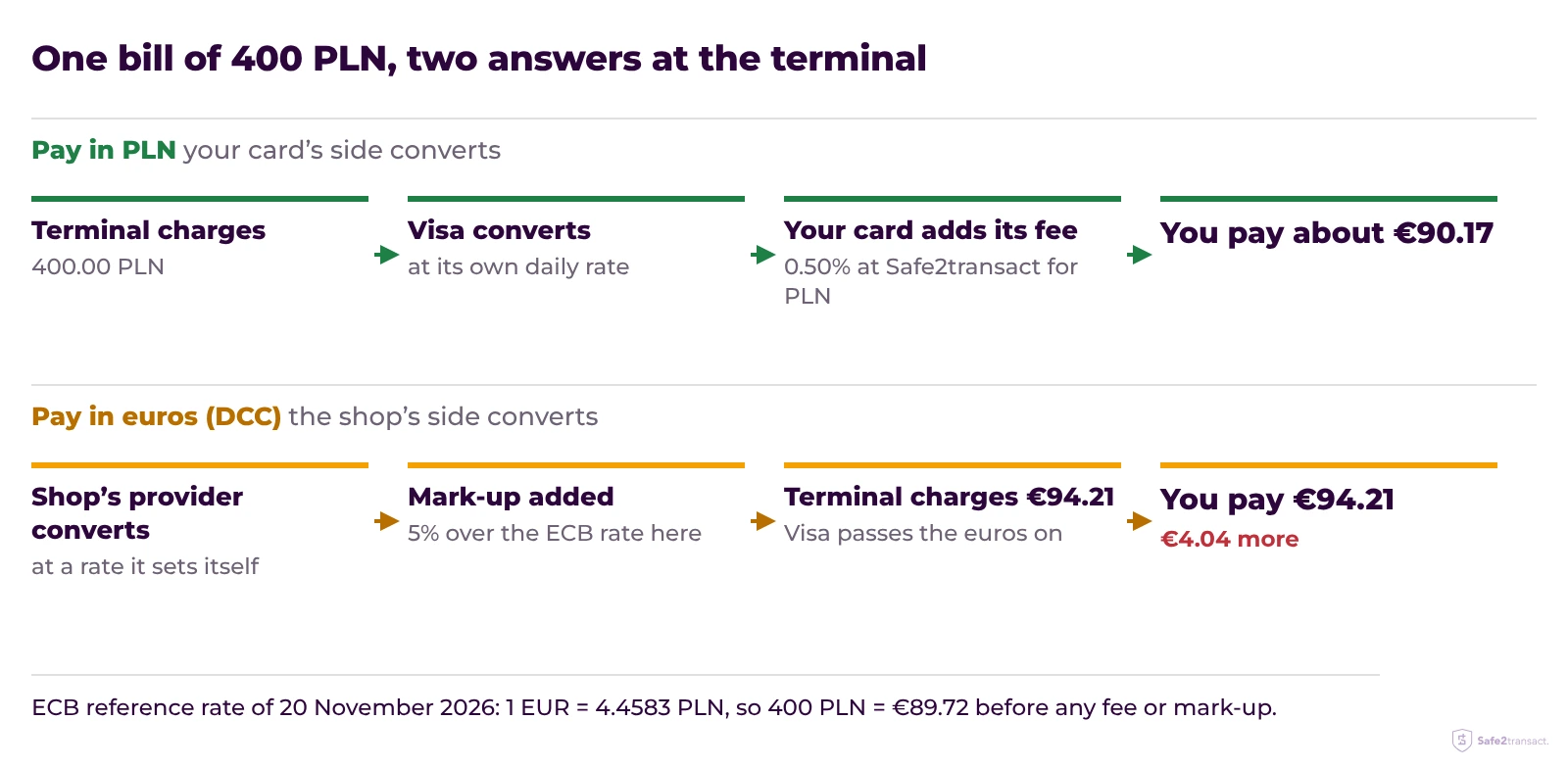
Pay in the local currency. The payment then reaches your card in Polish złoty, Swedish kronor or US dollars, Visa converts it at its daily rate, and your card provider adds the currency conversion fee it publishes in advance. This is how a payment card normally works abroad.
The euro answer is dynamic currency conversion. The terminal converts the price before the payment leaves the shop, at a rate its conversion provider chooses, and your card then sees an ordinary euro payment with nothing left to convert.
Consumer tests show how one-sided the choice is. BEUC, the European Consumer Organisation, collected them in October 2017: Stiftung Warentest's investigators in 13 non-euro countries paid 2.6% to 12% more at cash machines when they accepted the euro amount, and 2% to 5% more in shops; a Norwegian bank found the home-currency answer cheaper in only 4 of 1,500 withdrawals abroad.
What is dynamic currency conversion?
Dynamic currency conversion is the offer, at a terminal, cash machine or online checkout abroad, to charge your card in its own currency instead of the local one.
The offer pays the seller: BEUC quotes DCC providers promising merchants a commission on every converted payment. Your one gain is knowing the euro amount at the till, and BEUC notes that exchange rates usually move less in the day or two before a normal card conversion than the mark-up costs.
Where a currency conversion service is offered at an ATM or at the point of sale, it should be possible for the payer to refuse that service and to pay in the currency used by the payee instead.
How much more does paying in euros cost?
Paying in euros costs the difference between the shop's mark-up and your card's own conversion fee. Take a bill of 400 PLN in Kraków and the European Central Bank (ECB) reference rate of 20 November 2026, 1 EUR = 4.4583 PLN: at that rate the bill is worth €89.72.
| Pay in PLN | Pay in euros (DCC) | |
|---|---|---|
| Who converts | Visa, then your card provider adds its fee | The terminal's conversion provider |
| Rate used | Visa's daily rate | The provider's own rate: 1 EUR = 4.2458 PLN |
| Extra on top of the ECB rate | 0.50% Safe2transact fee for PLN | 5% mark-up in this example |
| Amount you pay | about €90.17 | €94.21 |
The mark-up the terminal shows is the euro amount compared with the ECB rate: (euro amount ÷ local amount × ECB rate) − 1. Here that is 94.21 ÷ 400 × 4.4583 − 1 = 5.0%. Compare it with your card's fee: if the mark-up is higher, the local currency is cheaper.
How do you spot the currency choice?
You spot it as two prices, one in the local currency and one in euros, on the terminal screen, the cash machine or the checkout page.
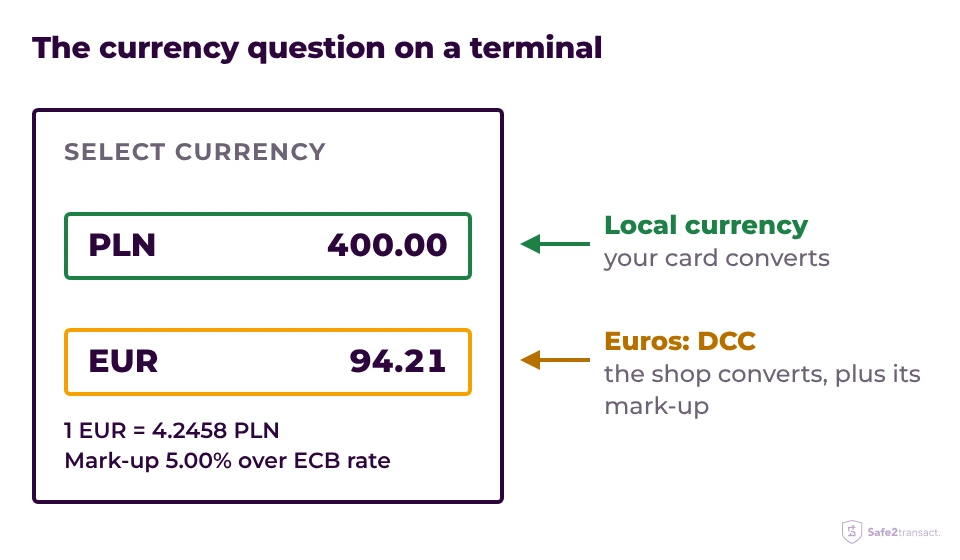
At a cash machine, where you need the physical card, the question often follows the PIN as "with conversion" or "without conversion"; "without conversion" means the local currency. Online, a foreign shop may show the total in euros next to a currency selector.
Look for two amounts
A screen with a local and a euro amount, or a question about your home currency, is a DCC offer.
Choose the local currency
Press the local currency, "without conversion" or "decline conversion". If the cashier asks, say you want to pay in the local currency.
Check the receipt
The receipt or the online confirmation should show the local amount. A receipt in euros with an exchange rate on it means DCC was applied.
What does EU law require before and after you pay?
EU law requires the terminal to show you, before you pay, the amount in the local currency, the amount in your card's currency and the conversion mark-up over the latest ECB reference rate, and to tell you that you can pay in the local currency instead.
The rule was added to Regulation (EC) No 924/2009 by Regulation (EU) 2019/518 as Article 3a and applies since 19 April 2020; the codified text, Regulation (EU) 2021/1230, keeps it as Article 4. Both amounts and the mark-up must also be given to you on a durable medium after the payment, such as the receipt, free of charge.
Since 19 April 2021 your own card provider has had a duty too. After a card payment or cash withdrawal in the currency of another EU country, it sends you an electronic message with its own mark-up over the ECB rate, once a month per currency, and you can opt out.
The ECB publishes euro reference rates for 29 currencies at around 16:00 CET on every working day, "for information purposes only". Providers convert at their own rates but must state their mark-up against the ECB rate, which makes the offers comparable.
What if you were charged in euros without being asked?
Act from the receipt: a euro amount with an exchange rate on it shows that DCC was applied, and DCC needs your agreement.
Keep the receipt
Photograph it, or save the confirmation email, with the date, the shop and both amounts if shown.
Ask the merchant first
Ask the shop or hotel to refund the payment and charge it again in the local currency, or to refund the mark-up. This is often the fastest fix.
Contact your card provider
If the merchant refuses, report the payment to your card provider. Visa's dispute rules list a currency conversion the cardholder did not agree to under "Incorrect currency" (dispute condition 12.3).
Weigh the amount first: a dispute takes weeks, and some providers charge for one; the Safe2transact fee schedule lists €45 for a chargeback or dispute.
What else does paying by card abroad cost?
Beyond the currency choice, a card payment abroad costs your provider's foreign exchange fee outside the euro area, and cash costs a withdrawal fee plus any charge the machine's owner adds.
Inside the euro area, now 21 countries since Bulgaria adopted the euro on 1 January 2026, nothing is converted. Regulation (EU) 2021/1230, Article 3, requires that a cross-border payment in euros costs the same as the corresponding payment at home, the same principle as for SEPA transfers.
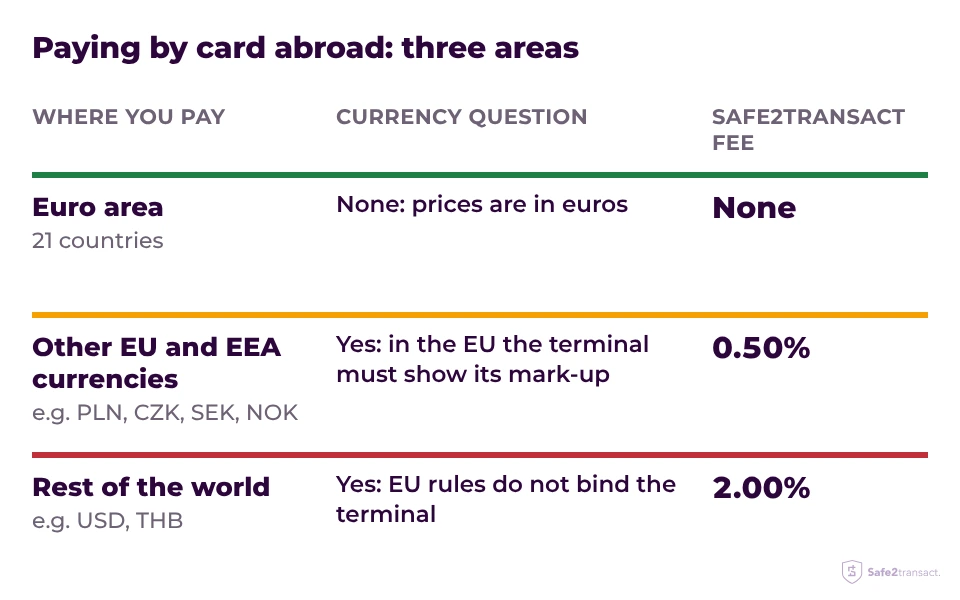
Safe2transact, for example, charges in euros and publishes these card fees on its pricing page:
- Foreign exchange fee: none in the euro area, 0.50% in non-euro countries in Europe and the EEA, 2.00% in the rest of the world.
- Cash machine withdrawals: €1.50 + 1% in the card-issuing country and in non-euro countries in Europe and the EEA, €2.00 + 3% in the rest of the world.
- Balance enquiry at a cash machine: €1.00.
Some cash machines add their own operator fee, set by the machine's owner, not your card provider. Safe2transact customers find travel tips and what to check when a card is declined in using your card abroad.
The Safe2transact Visa card pays wherever Visa is accepted, online and at terminals and cash machines with the Visa logo. It is issued to residents of the countries eligible for the Visa debit card.
Frequently asked questions
Is paying in euros ever cheaper?
Only when your card's conversion fee is higher than the terminal's mark-up, for example a card that charges 3% against a terminal that adds 2.6%. With a card that charges 0.50% to 2.00%, the local currency usually wins.
Which currencies does the EU message about my card's mark-up cover?
The currencies of EU countries outside the euro area: Czech koruna, Danish krone, Hungarian forint, Polish złoty, Romanian leu and Swedish krona. The rule doesn't require it for US dollars or other non-EU currencies, and you can opt out of the message.
What happens to hotel deposits and refunds in another currency?
A deposit or refund in another currency is converted again when it is released or paid back, at that day's rate, so the euro amount you get back can differ from the amount taken, in either direction. Keep the receipt to compare the two.
IBAN and Visa card issuance and payment services are provided by Stanhope Financial UAB, a company registered in Lithuania (a member state of the European Union) with company code 305574870 and a registered address at Konstitucijos pr. 7, Vilnius, Lithuania. Stanhope Financial UAB is an Electronic Money Institution (EMI licence No. 78) authorized and regulated by the Bank of Lithuania. Access to your IBAN account and your VISA card is technically provided through the Safe2transact platform.