What is cryptocurrency, and how does it work?
Cryptocurrency is a digital asset recorded on a shared ledger, the blockchain, and moved with cryptographic keys instead of through a bank. In the EU it is called a crypto-asset and regulated by MiCA.
This article is the first step of our crypto basics guide.
What is cryptocurrency?
Cryptocurrency is a digital asset whose ownership is recorded on a blockchain and transferred by signing with a private key, without a bank or card network in between. Bitcoin started the category on 3 January 2009, when its first block was created; thousands of crypto-assets have followed. The legal term in the EU is broader and covers every asset of this kind.
A purely peer-to-peer version of electronic cash would allow online payments to be sent directly from one party to another without going through a financial institution.
How does a blockchain record transactions?
A blockchain records transactions in blocks that are chained together by cryptographic hashes, and every participating computer (a node) keeps its own full copy. There is no central copy: the nodes check each new block against the rules and against each other, and accept it only when it fits.
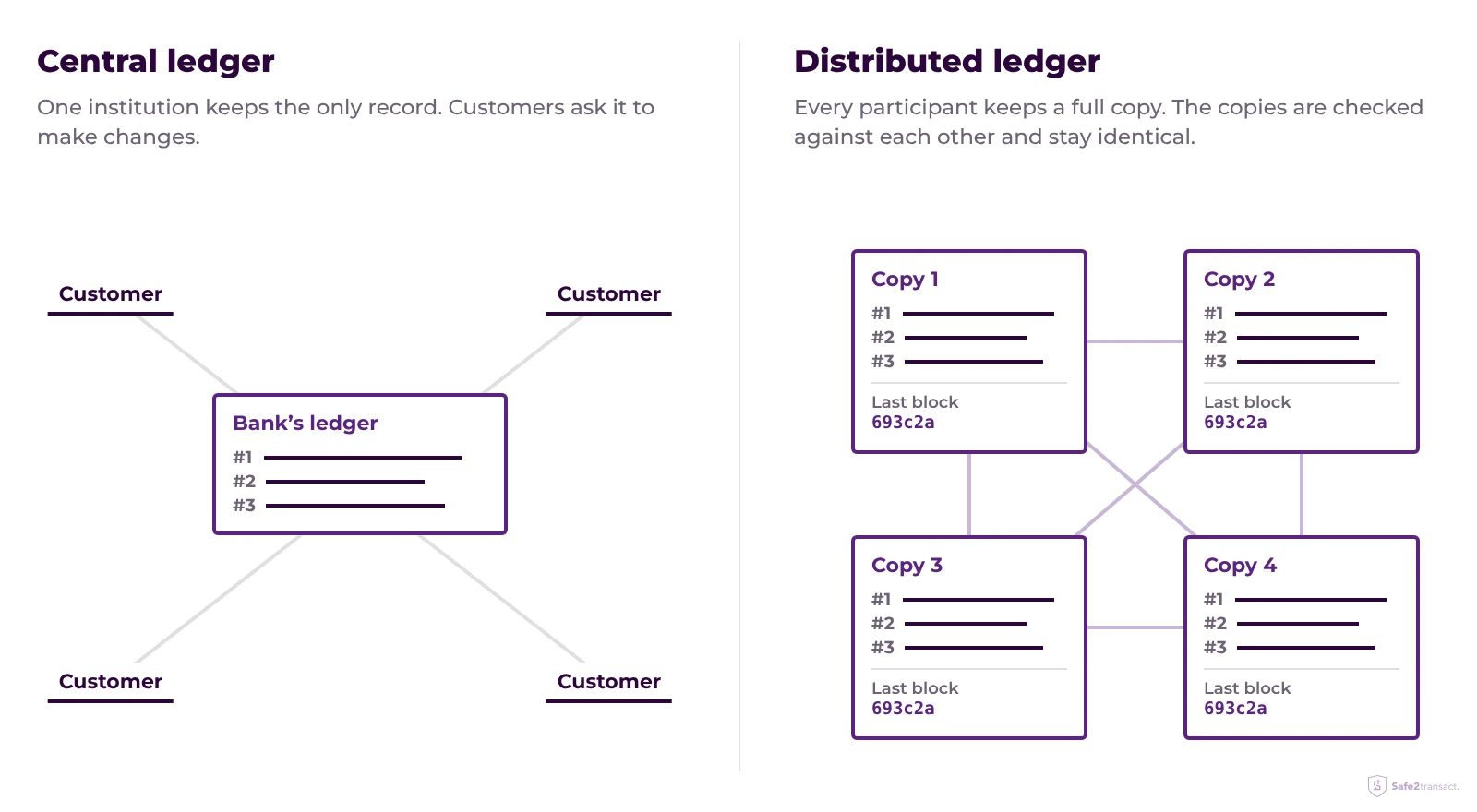
Each block carries a hash, a short fingerprint calculated from the block's contents and from the previous block's hash. Change one old entry and its hash changes, then the hash of every block after it. The edited copy no longer matches the others, and the network ignores it.
What do keys and wallets do?
A private key is a secret number that signs transfers; the matching address, derived from the public key, is where others send crypto. On Bitcoin and Ethereum the private key is a 256-bit number. A crypto wallet is the software or device that stores the keys and signs with them: the crypto itself always stays on the blockchain.
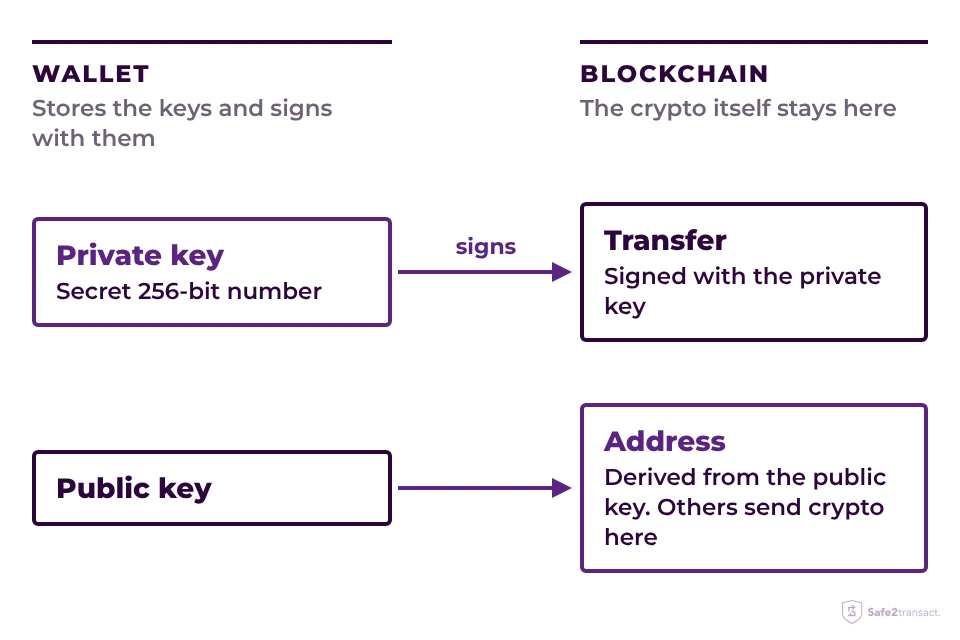
Most wallets back up the keys as a recovery phrase of 12 or 24 words. Anyone who reads that phrase controls the funds.
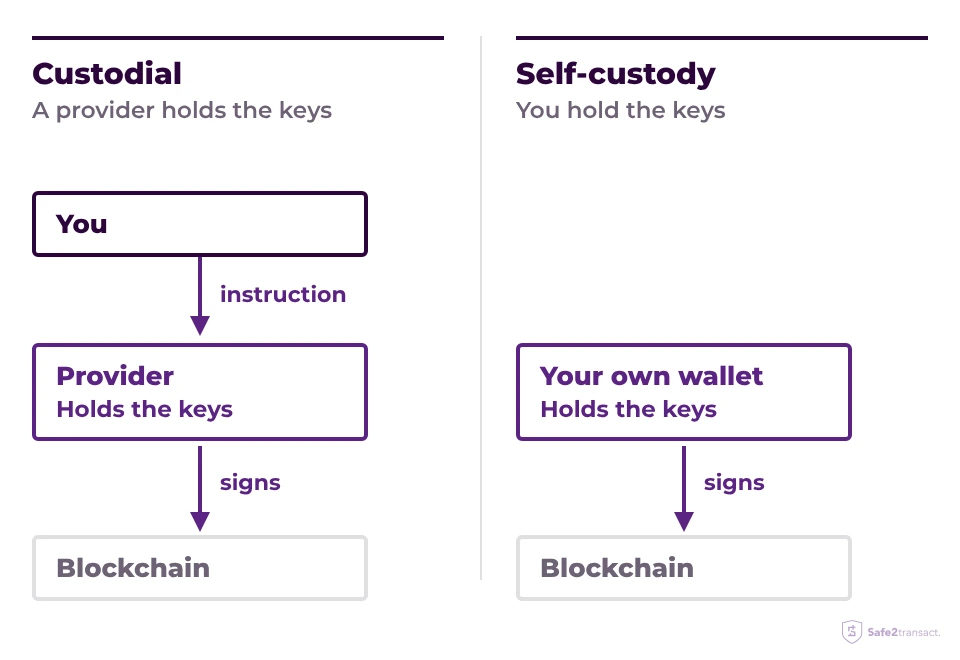
| Custodial (a provider holds the keys) | Self-custody (you hold the keys) | |
|---|---|---|
| Who signs transfers | The provider, on your instruction | You, in your own wallet |
| Lost password or phone | The provider restores access after checking your identity | Only your recovery phrase restores access |
| Rules that apply | MiCA: an authorised provider must safeguard clients' crypto-assets, also in its insolvency (Article 70) | No provider involved; the security is up to you |
| Typical use | Buying, selling and holding in an app | Holding outside any provider |
How is a crypto transaction confirmed?
A crypto transaction is confirmed when the network adds it to a block; each later block adds one more confirmation. The process takes from seconds to about an hour, depending on the network and the number of confirmations a receiver waits for.
The sender signs
The wallet builds the transfer (amount, receiving address, network fee) and signs it with the private key.
The network checks
Nodes verify the signature and that the sender's address holds enough funds. A transfer that fails either check is dropped.
A block includes it
On Bitcoin, miners compete with computing power (proof of work) and add a block about every 10 minutes. On Ethereum, which moved to proof of stake in September 2022, a validator proposes a block every 12-second slot.
Confirmations build up
Every new block on top makes the transfer harder to undo. Providers and wallets credit an incoming transfer after their own number of confirmations.
Every transfer runs on one specific network: blockchain networks and why the network must match shows why sending on the wrong one loses funds, and what a TXID is and how to track a transfer explains how to follow it on a block explorer.
What types of crypto-assets are there?
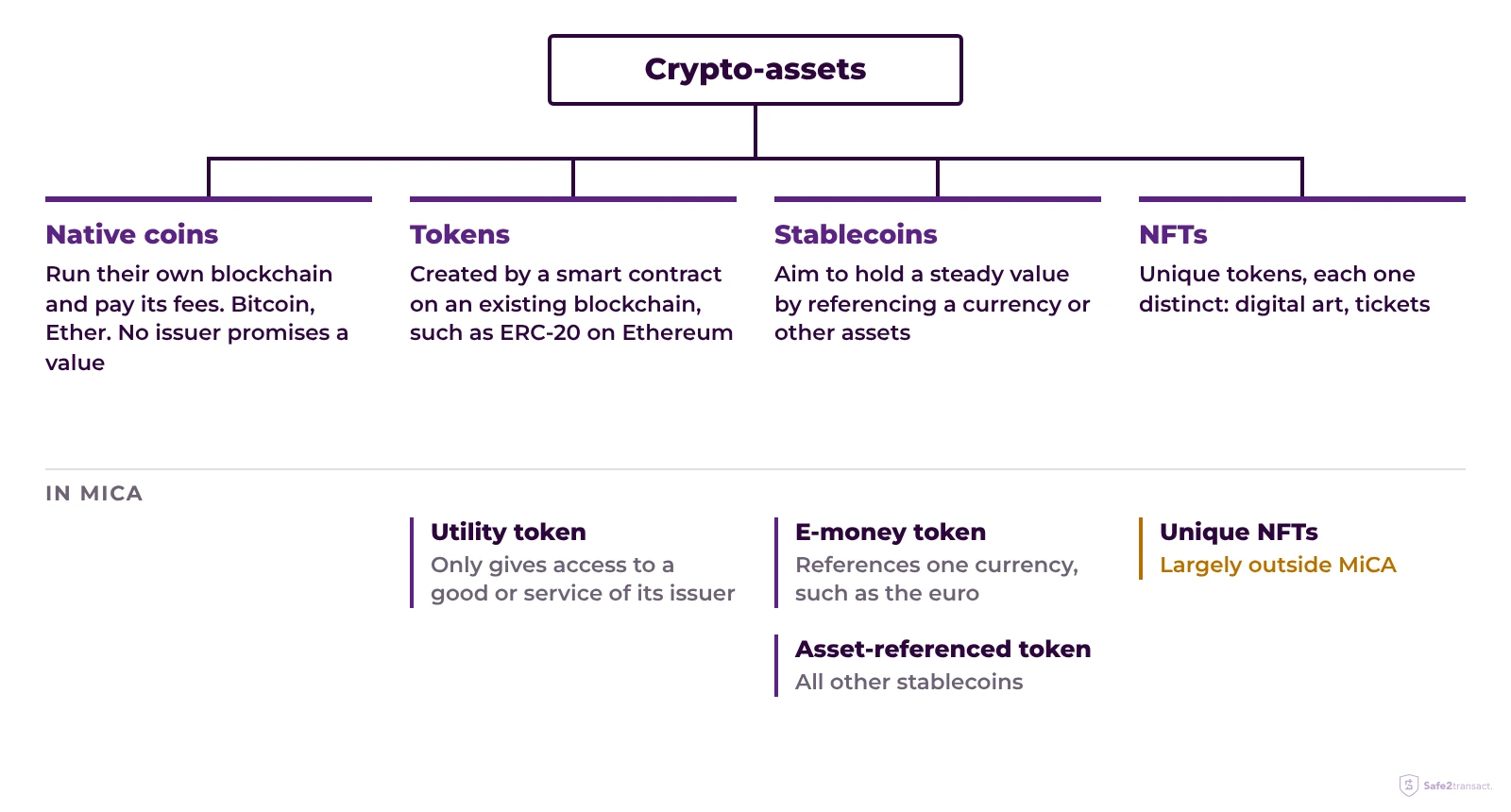
Crypto-assets fall into four broad groups: native coins, tokens, stablecoins and non-fungible tokens (NFTs). The group decides who stands behind the asset, if anyone, and which MiCA rules apply.
- Native coins run their own blockchain and pay its fees. Bitcoin and Ether are the best-known examples. No issuer promises a value.
- Tokens are created by a smart contract on an existing blockchain, such as the ERC-20 standard on Ethereum. MiCA names one kind, the utility token, which only gives access to a good or service of its issuer.
- Stablecoins aim to hold a steady value by referencing a currency or other assets. MiCA calls them e-money tokens when they reference one currency, such as the euro, and asset-referenced tokens otherwise.
- NFTs are unique tokens, each one distinct, used for items such as digital art or tickets. Unique NFTs are largely outside MiCA.
How is crypto different from money in a payment account?
Euros in a payment account keep their face value and come with payment rules for mistakes; crypto-assets change value constantly, and a confirmed transfer is final.
| Euros in a payment account | Crypto-assets | |
|---|---|---|
| Value | 1 euro stays 1 euro | Set by the market; it can fall sharply, even to zero |
| Who keeps the record | The bank or electronic money institution | A blockchain, in copies kept by many nodes |
| Protection | Bank deposits: deposit guarantee up to EUR 100,000 (Directive 2014/49/EU). E-money: safeguarded by the institution, kept apart from its own money | No deposit guarantee and no investor compensation |
| A payment sent by mistake | The payment provider can request a recall | A confirmed transfer can't be reversed |
| When it moves | SEPA Instant: around the clock, within seconds | Around the clock, at the network's pace |
Crypto has no legal tender status in the EU, so a shop or a landlord doesn't have to accept it.
How is crypto regulated in the EU?
Crypto in the EU is regulated by MiCA, Regulation (EU) 2023/1114: every firm that holds, trades or transfers crypto-assets for clients needs an authorisation as a crypto-asset service provider (CASP). The transitional period for firms already active under national rules ended on 1 July 2026, so a provider without that authorisation may no longer serve EU clients. What MiCA is and how to check a crypto provider covers the rules for stablecoins, white papers and marketing, and the search in ESMA's register.
What are the main risks and scams?
The main crypto risks are sharp price falls, transfers that can't be reversed, lost keys and fraud.
- Volatility. The price of a crypto-asset rises and falls sharply, sometimes within hours, and it can drop to zero.
- Fake platforms and impersonation. Scammers pose as a provider, a celebrity or the police, and ask for a transfer or for the recovery phrase.
- Promises of fixed returns. A guaranteed profit is a hallmark of investment fraud.
- Recovery scams. After a loss, fake "recovery services" ask for an upfront fee and take it.
Frequently asked questions
Is cryptocurrency legal in the EU?
Yes. Owning, buying and selling crypto-assets is legal in every EU country. Tax rules on gains differ by country.
Who controls the price of a cryptocurrency?
Nobody sets it. The price comes from supply and demand on trading venues, which is why it moves around the clock.
Is crypto held in an app protected like a deposit?
No. Crypto-assets are not covered by deposit guarantee or investor compensation schemes. MiCA makes an authorised provider protect clients' ownership if it fails, but nobody guarantees the market value.