What is a TXID? Transaction hashes and confirmations explained
A TXID (transaction ID or transaction hash) is the unique fingerprint of one transaction on a blockchain. With it, anyone can look the transfer up on a block explorer and see whether it is waiting, in a block or confirmed.
When crypto moves between wallets, the TXID is the first of the crypto basics to know.
What is a TXID?
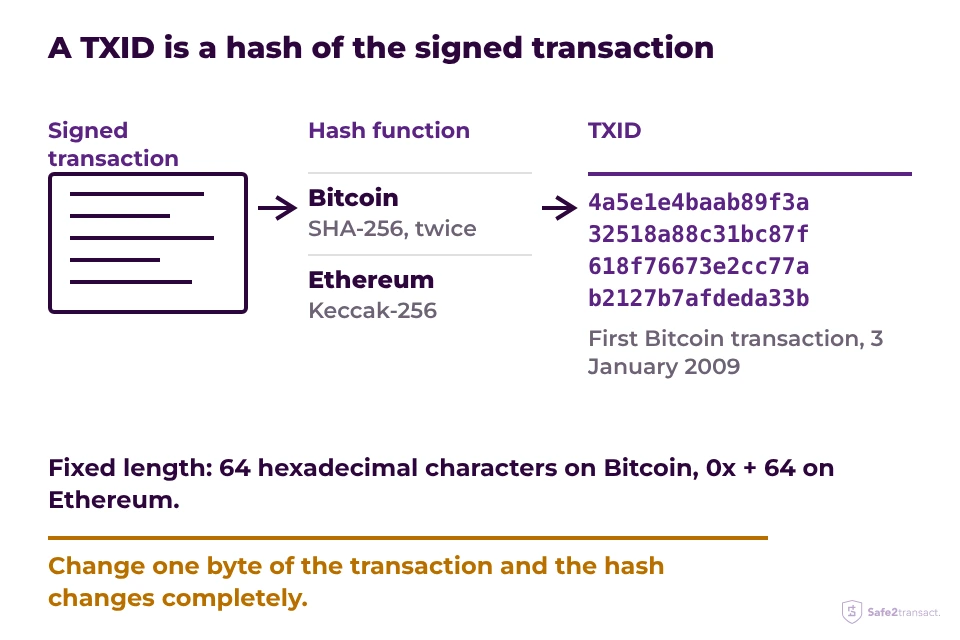
A TXID is a cryptographic hash of a signed transaction: a fixed-length string calculated from the transaction's data, unique to that transaction. Change one byte of the transaction, and the hash changes completely. Bitcoin calculates the TXID by running SHA-256 twice over the transaction; Ethereum uses Keccak-256 over the signed transaction. Every cryptocurrency transfer that is written to a public blockchain gets one.
What does a TXID look like?
A TXID looks like a long string of letters and digits whose length and alphabet are fixed by the network.
| Name used | Format | Length | |
|---|---|---|---|
| Bitcoin | TXID, transaction ID | Hexadecimal (0–9, a–f) | 64 characters |
| Ethereum and its tokens | Transaction hash, Txn Hash | 0x + hexadecimal | 66 characters |
| XRP Ledger | Transaction hash | Hexadecimal, usually in capitals | 64 characters |
| Solana | Transaction signature | Base58 (no 0, O, I or l) | up to 88 characters |
The first Bitcoin transaction ever recorded, in the genesis block of 3 January 2009, has the TXID 4a5e1e4baab89f3a32518a88c31bc87f618f76673e2cc77ab2127b7afdeda33b. A token such as USDC on Ethereum uses Ethereum's format, because the transfer is an Ethereum transaction; why the same asset behaves differently per chain is covered in blockchain networks explained.
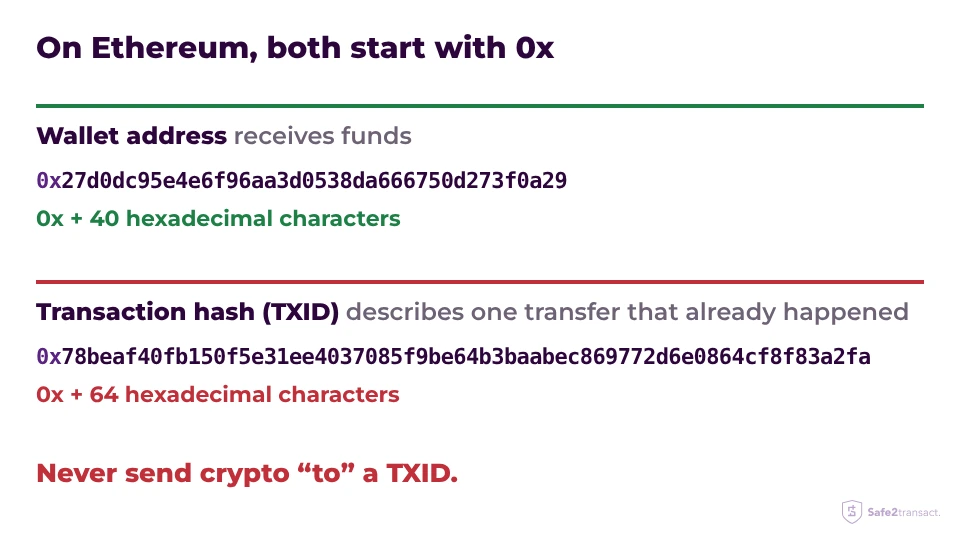
Where do you find the TXID of a transfer?
The TXID sits in the transaction details of the wallet or service that sent the crypto. Most wallets show it as "Transaction ID", "TxID" or "Hash", often with a copy button, or as a "View on explorer" link whose URL ends with the TXID. Three places cover almost every case:
- The sender's wallet or provider. The person or service that sent the crypto always has the TXID, because their wallet created it. Ask them for it when a transfer you expect hasn't arrived.
- Your own transaction history. A received transfer usually shows the TXID or an explorer link in its details.
- A block explorer. Search the receiving address and the explorer lists every transaction to and from it, each with its TXID.
In the Safe2transact app, crypto you receive from an external wallet appears under the Crypto tab; its Crypto transaction details have a Blockchain row with a View on Explorer link. The link opens the block explorer for that network, and its address ends with the TXID.
How do you look up a TXID on a block explorer?
A block explorer is a website that reads a blockchain and shows its blocks, addresses and transactions in plain form.
Check the network
Find out on which network the crypto was sent: Bitcoin, Ethereum, XRP Ledger or another chain. The asset alone isn't enough, because USDC, for example, exists on several networks.
Open an explorer for that network
Each network has its own explorers, such as Blockstream for Bitcoin, Etherscan for Ethereum and its tokens, and the XRPL Explorer for the XRP Ledger.
Paste the full TXID
Copy the TXID with the copy button rather than by hand. A single missing character gives "not found".
Read the result
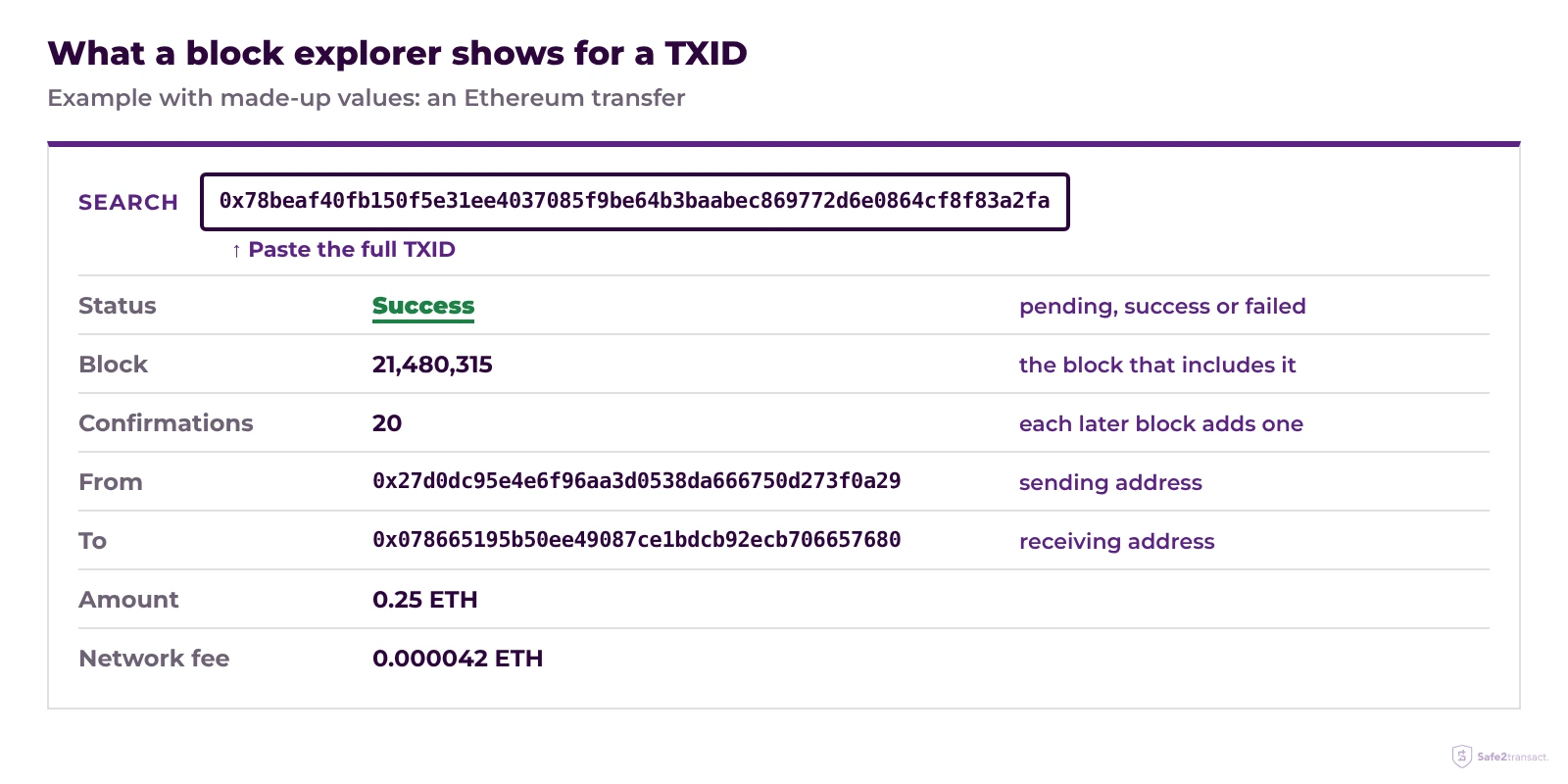
The page shows the status (pending, success, failed), the block number, the confirmations, the sending and receiving addresses, the amount and the network fee.
What happens to a transfer after you press send?
A crypto transfer goes through six stages: signed, broadcast, waiting in the mempool, included in a block, confirmed by further blocks, and final. The TXID is fixed at the first stage, which is why a sender can share it seconds after pressing send, long before the recipient sees the funds.
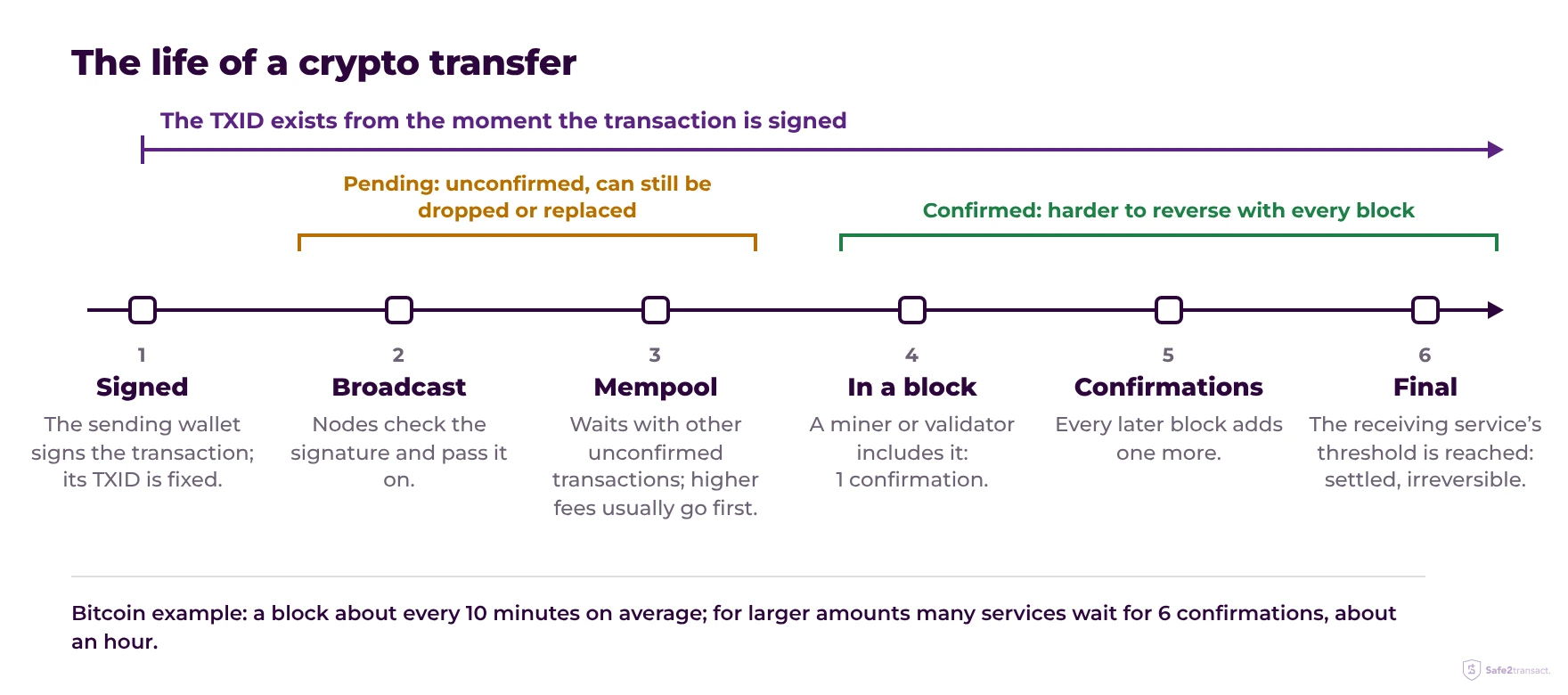
The mempool is each node's waiting room for valid transactions that no block has included yet. Miners (Bitcoin) and validators (Ethereum) build each new block from it and usually pick transactions that pay higher fees first.
What are blockchain confirmations?
A confirmation is a block that includes the transaction or is built on top of it. Each extra block makes the transaction harder to undo, because rewriting it would mean rebuilding every block after it.
| New block or ledger | When a transfer counts as settled | Typical wait | |
|---|---|---|---|
| Bitcoin | About every 10 minutes on average | Many services wait for 6 confirmations for larger amounts | About 1 hour |
| Ethereum | A slot every 12 seconds; 32 slots make an epoch | Finalized after about two epochs | 13 to 15 minutes |
| XRP Ledger | A new ledger version every few seconds (3 to 5) | Final once in a validated ledger, nothing to count | A few seconds |
The figures come from each network's own documentation. Bitcoin's developer guide advises waiting "for at least six confirmations" for high-value payments. Ethereum.org places finality "across two epochs", after which reverting a block would cost an attacker at least a third of all staked ether. The XRP Ledger documentation calls a result "final when included in a validated ledger".
The TXID proves that a transfer exists. Only the confirmations show how settled it is.
How many confirmations are enough?
The receiving service sets the number, not the sender and not the network. A service weighs the network's security against speed and the amounts involved, so two services can wait for different numbers on the same network.
Why is a crypto transfer still pending?
A transfer stays pending while it waits in the mempool or until it reaches the confirmation threshold of the service receiving it. Five causes explain almost every delay:
- A low fee on a busy network. The transaction waits until blocks have room for it. Some wallets offer a speed-up (on Bitcoin, replace-by-fee): it sends a new version with a higher fee, which gets a new TXID, and the old one disappears.
- The receiving service's threshold. The explorer shows confirmations, but the service waits for more before crediting the funds.
- A compliance check. Under the EU Transfer of Funds Regulation (Regulation (EU) 2023/1113, the "Travel Rule"), crypto-asset service providers collect and check information on the sender and recipient, and may hold a transfer while they do.
- The wrong network. Funds sent on a network the recipient doesn't support may not arrive at all, and recovering them, if possible, takes manual work.
- A dropped transaction. A transaction left too long in the mempool can be removed by the nodes. The funds never left the sender's wallet, and the transfer can be sent again.
In Safe2transact, crypto you receive shows up in your transactions only after BitGo, which provides the crypto services, has confirmed the transfer on the blockchain, and it then appears as completed. What each status in the app means is in crypto transactions explained: statuses and why a transaction can be pending.
How do you use a TXID when you contact support?
The TXID is the fastest way for a support team to find a transfer, because it points at one transaction on one network with no room for doubt. Send the team:
- the full TXID, copied rather than typed or shortened;
- the network and the asset, for example USDC on Ethereum;
- the amount and the date and time it was sent;
- the sending and receiving addresses.
A confirmed blockchain transfer can't be reversed, so support can trace a transfer and explain its status, but it can't pull the funds back from the recipient.
In the Safe2transact app, the details of each crypto transaction end with Questions about this transaction? and a Contact support button, which keeps the transaction attached to the request. Other ways to reach the team are in how to contact support.
Frequently asked questions
Is it safe to share a TXID?
Yes. A TXID gives nobody access to funds. It does reveal the addresses involved and the amount, and through them the other transactions of those addresses, so share it with the people who need to trace the transfer rather than publicly.
Can a TXID change?
Not once the transaction is in a block. Before that, a speed-up or cancellation replaces it with a new transaction, and the old TXID shows as dropped or replaced: use the TXID of the confirmed version.
Do buys, sells and swaps have a TXID?
Not necessarily. A trade inside a custodial platform is often settled in the provider's own records rather than as a separate blockchain transaction, so it has no TXID of its own. Transfers between a wallet and an outside address always go on-chain and always have one.
Crypto-asset services are provided by BitGo Europe GmbH, a crypto-asset service provider authorised under the Markets in Crypto-Assets Regulation (MiCA). Safe2transact does not provide crypto-asset services. Crypto-assets are volatile: their value can go down as well as up, you may lose part or all of the amount you buy, and they are not covered by deposit guarantee or investor compensation schemes.