Blockchain networks explained: how to pick the right network
A blockchain network is the system a crypto transfer travels on. The same asset can exist on several networks as separate tokens, so a transfer arrives only when the sender and the receiver use the same network.
Choosing the network is one of the first practical skills in crypto basics.
What is a blockchain network?
A blockchain network is a group of computers (nodes) that run the same blockchain and agree on one shared record of transactions.
Bitcoin, Ethereum, Solana, Tron, the XRP Ledger and Stellar are separate networks. Each one runs independently and moves at its own pace: the Bitcoin network adds a block about every 10 minutes on average, while Ethereum works in 12-second slots. A network's native coin, such as BTC on Bitcoin or ETH on Ethereum, is the cryptocurrency it was built around.
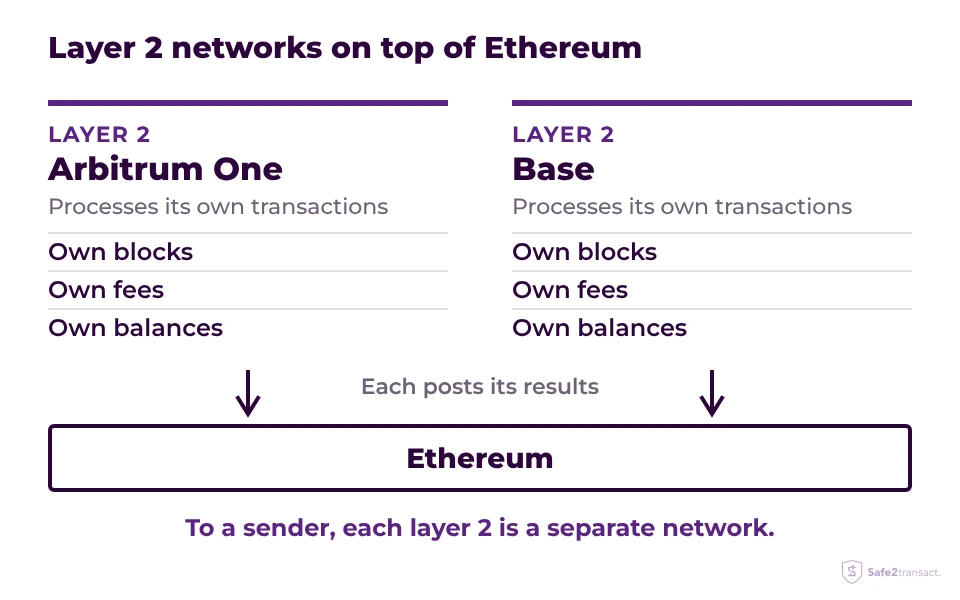
Some networks are built on top of others. Arbitrum One and Base are layer 2 networks: they process transactions themselves and post the results to Ethereum, but they keep their own blocks, fees and balances. To a sender, a layer 2 is a separate network.
How can the same token exist on several networks?
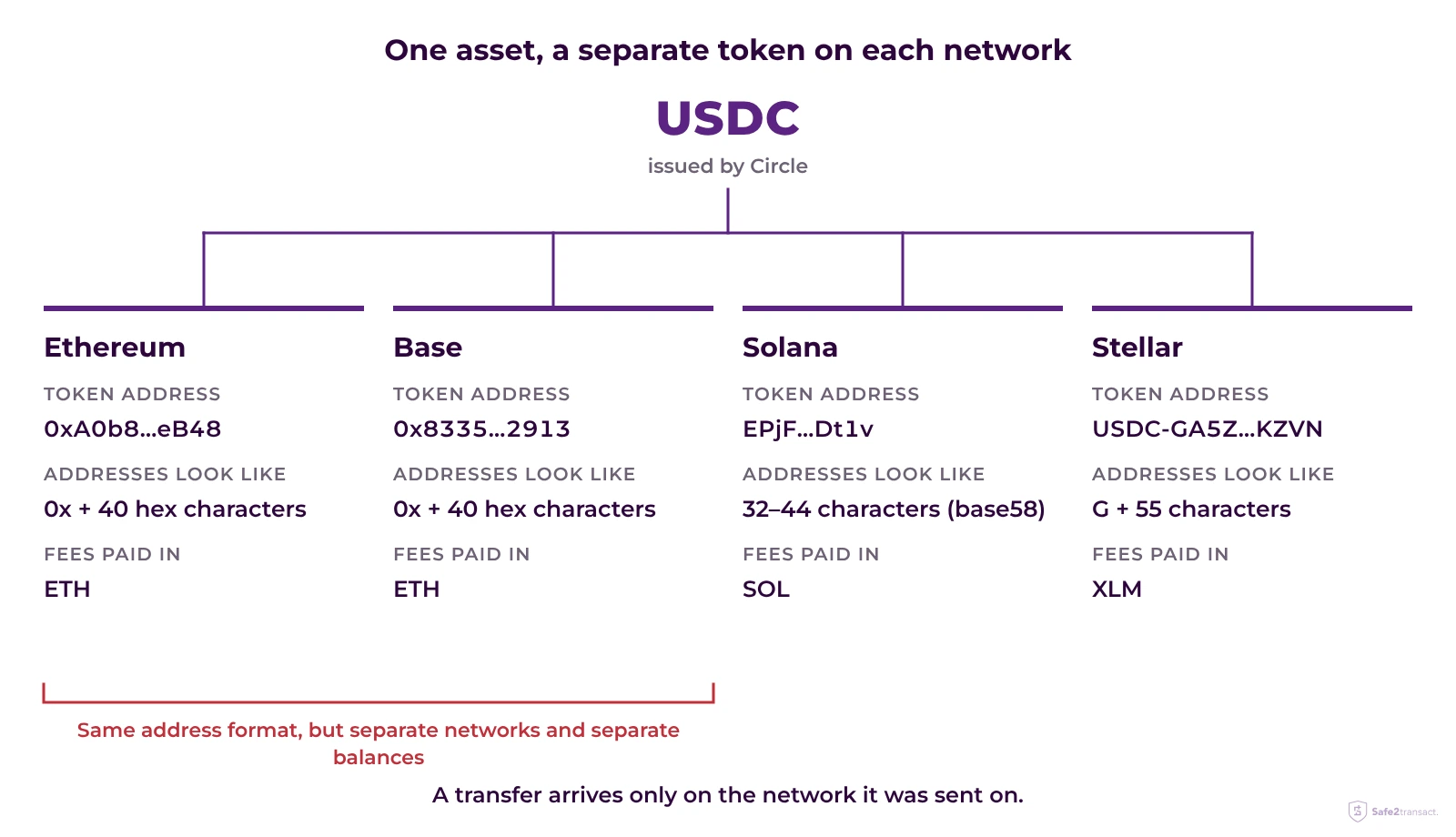
One asset exists on several networks because its issuer creates a separate token on each of them. Circle issues USDC on Ethereum, Solana, Base, Arbitrum One, Stellar and other networks, and each version has its own token address: on Ethereum, USDC is the contract 0xA0b86991c6218b36c1d19D4a2e9Eb0cE3606eB48; on Solana, it's the token EPjFWdd5AufqSSqeM2qN1xzybapC8G4wEGGkZwyTDt1v (Circle, "USDC contract addresses").
Tether does the same with USDT. Tether lists Ethereum, Tron and Solana among the networks it issues USDT on; it doesn't list Base or Arbitrum One. USDT on Ethereum follows the ERC-20 token standard, and USDT on Tron follows TRC-20. Both are called USDT and both track the US dollar, yet they're two separate tokens on two separate ledgers.
A token can also reach a network its issuer doesn't support, through a bridge. A bridged or "wrapped" token, such as Wrapped Bitcoin (WBTC) on Ethereum, is a new token backed by assets locked elsewhere. It isn't the original asset: WBTC on Ethereum is not BTC, and a Bitcoin address can't receive it.
Why must the sender and receiver use the same network?
A transfer arrives only if the sender and receiver use the same network, because every balance exists on exactly one ledger. USDC sent on Solana is recorded only on Solana's ledger; a receiver watching Ethereum never sees it.
Address formats help, but only partly. Bitcoin addresses start with bc1, 1 or 3; Tron addresses start with T; Solana addresses are 32 to 44 letters and digits. A wallet refuses an address that doesn't fit the network you selected. Ethereum and every network compatible with it (the EVM networks, such as Arbitrum One, Base and BNB Smart Chain) share one format: 0x followed by 40 hexadecimal characters. The same key even produces the same address on all of them, so a wallet accepts an Ethereum address on Base without complaint.
What happens if you send crypto on the wrong network?
Crypto sent on the wrong network usually doesn't arrive, and a confirmed blockchain transfer can't be reversed by the sender. What happens next depends on how the mismatch happened:
| Mismatch | What happens | Can it be recovered? |
|---|---|---|
| Address doesn't fit the network | The wallet refuses the transfer | Nothing was sent |
| Same address format, different network (two EVM networks) | The funds arrive at that address on the network you used | Only if the receiver controls that address there and is willing to help |
| Asset not supported by the receiver at that address | The funds sit at an address the receiver's systems don't credit | Depends on the receiver; some providers can't recover at all |
A self-custody wallet holder who controls the private key can often reach funds sent to their address on another EVM network by adding that network to the wallet. A provider's deposit address is different: the provider may not hold keys for that address on the other network, or may charge for a manual recovery, and nothing obliges it to try.
An address that looks right proves nothing: the asset, the network and the address all have to match.
What are network fees, and why do they differ?
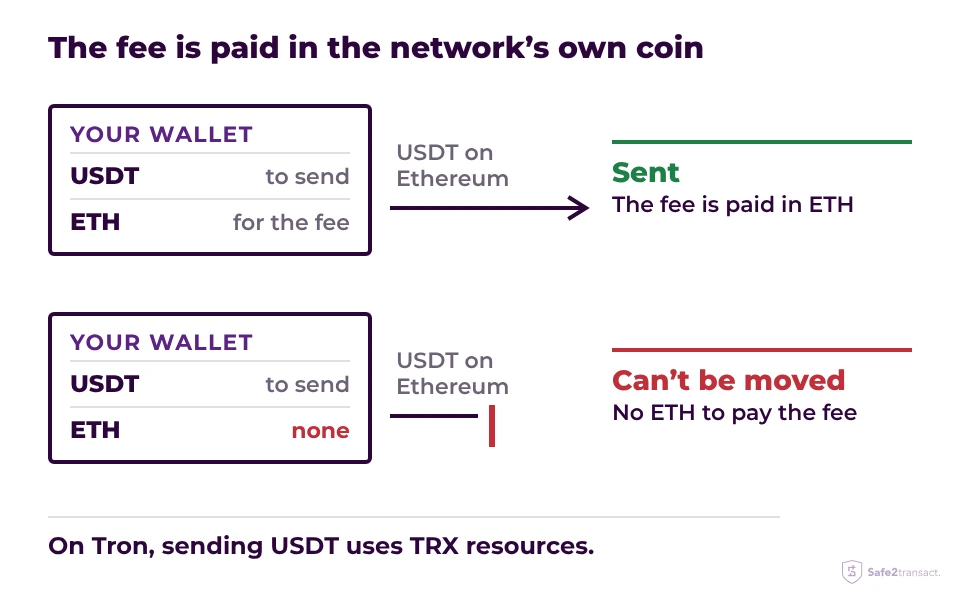
A network fee is the amount a transfer pays the network to be processed, and it's always paid in the network's own coin. On Ethereum, the fee is called gas: every transaction uses a number of gas units, and the fee is the gas used multiplied by the base fee plus an optional priority fee. A plain ETH transfer uses 21,000 gas units. The protocol burns the base fee and the validator keeps the priority fee (ethereum.org, "Gas and fees").
Fees differ between networks and over time for four reasons:
- Demand: when many people want into the next block, the base fee on Ethereum rises and Bitcoin users bid higher fee rates.
- Transaction size: Bitcoin fees are priced per virtual byte of transaction data, not per euro sent, so a transfer of 0.01 BTC can cost as much as one of 1 BTC.
- Complexity: a token transfer runs a contract, so an ERC-20 transfer uses more gas than a plain ETH transfer.
- Network design: layer 2 networks bundle many transactions into one Ethereum posting, which makes each transfer cheaper than on Ethereum itself.
The fee coin matters too. Sending USDT on Ethereum costs ETH, and sending it on Tron uses TRX resources, so a wallet holding only USDT can't move it. The TXID guide shows how to follow a transfer until it's confirmed.
When do you need a memo or destination tag?
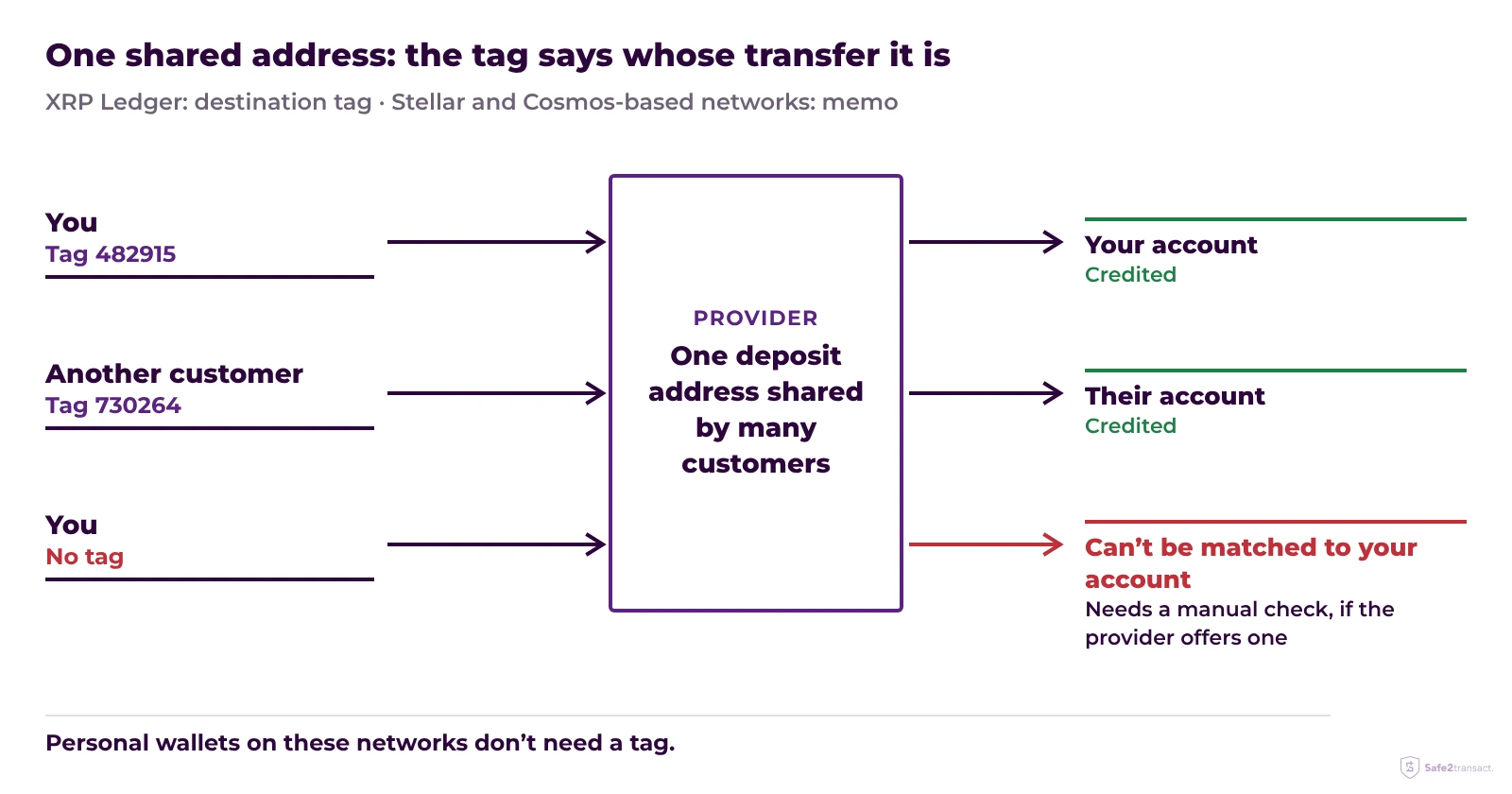
A memo or destination tag is needed when the receiver shares one address among many customers and uses a second identifier to tell them apart. The XRP Ledger calls it a destination tag, a number attached to the payment; Stellar calls it a memo; Cosmos-based networks also use memos.
If a provider shows a tag or memo next to its address, it's part of the address. Without it, the funds usually reach the provider but can't be matched to your account, and crediting them means a manual check that the provider may or may not offer. Personal wallets on these networks don't need a tag.
How do you choose the right network?
The right network is the one the receiver names for that asset, matched in your sending wallet.
Ask the receiver which network to use
Take the network from the receiver's deposit screen or from the person you're paying, not from what your own wallet suggests first.
Select the same asset and network when you send
Pick the asset, then the network with exactly that name: "Ethereum" and "Arbitrum One" are different choices even when the address field accepts the same address.
Copy the full address and check both ends
Paste the address instead of typing it, then compare the first and last four characters with the source.
Add the memo or tag if the receiver asks for one
Enter it in the separate memo or tag field, never in the address field.
Check the fee and any minimum
Make sure you hold enough of the network's coin for the fee, and that the amount is above any minimum the sender or receiver applies.
Send a small test amount first
On a route you haven't used before, a small transfer that arrives proves the asset, network and address before the full amount moves.
Keep the transaction ID
The transaction ID (TXID) lets you and the receiver look the transfer up on a block explorer.
Frequently asked questions
Can a crypto transfer be cancelled after it's sent?
No. Once a blockchain transfer is included in a block, no one can cancel or reverse it, including the wallet that sent it. Only the receiver can send the funds back, as a new transfer. Before inclusion, some wallets let you replace a pending transaction with a higher fee, but that isn't a cancellation you can count on.
Why does my wallet show the same address on several networks?
Ethereum and the EVM networks derive addresses the same way, but each keeps its own balances: 100 USDC on Base at that address says nothing about the same address on Ethereum.
Who receives the network fee?
The network, not the wallet provider. On Bitcoin, the miner who adds the block collects the fees. A provider may charge its own fee on top, which it lists separately.
Crypto-asset services are provided by BitGo Europe GmbH, a crypto-asset service provider authorised under the Markets in Crypto-Assets Regulation (MiCA). Safe2transact does not provide crypto-asset services. Crypto-assets are volatile: their value can go down as well as up, you may lose part or all of the amount you buy, and they are not covered by deposit guarantee or investor compensation schemes.