What is MiCA, and how do you check a crypto provider?
MiCA, the Markets in Crypto-Assets Regulation (EU) 2023/1114, is the EU law that licenses crypto providers and sets rules for stablecoins, white papers and crypto marketing. It applies in full since 30 December 2024.
MiCA sets the EU rules behind the crypto basics: who may offer crypto services, and what they must tell you.
What is MiCA?
MiCA is the Markets in Crypto-Assets Regulation, Regulation (EU) 2023/1114 of 31 May 2023: the EU law that sets uniform rules for issuing, offering and trading crypto-assets and for the firms that provide crypto services. As a regulation, MiCA applies directly in every member state, with no national version needed. It replaced the separate national registrations for crypto firms with one EU authorisation.
MiCA uses the term crypto-asset for every cryptocurrency and token: a digital representation of a value or a right that is transferred and stored electronically using distributed ledger technology (Article 3(1)(5)).
When did MiCA start to apply?
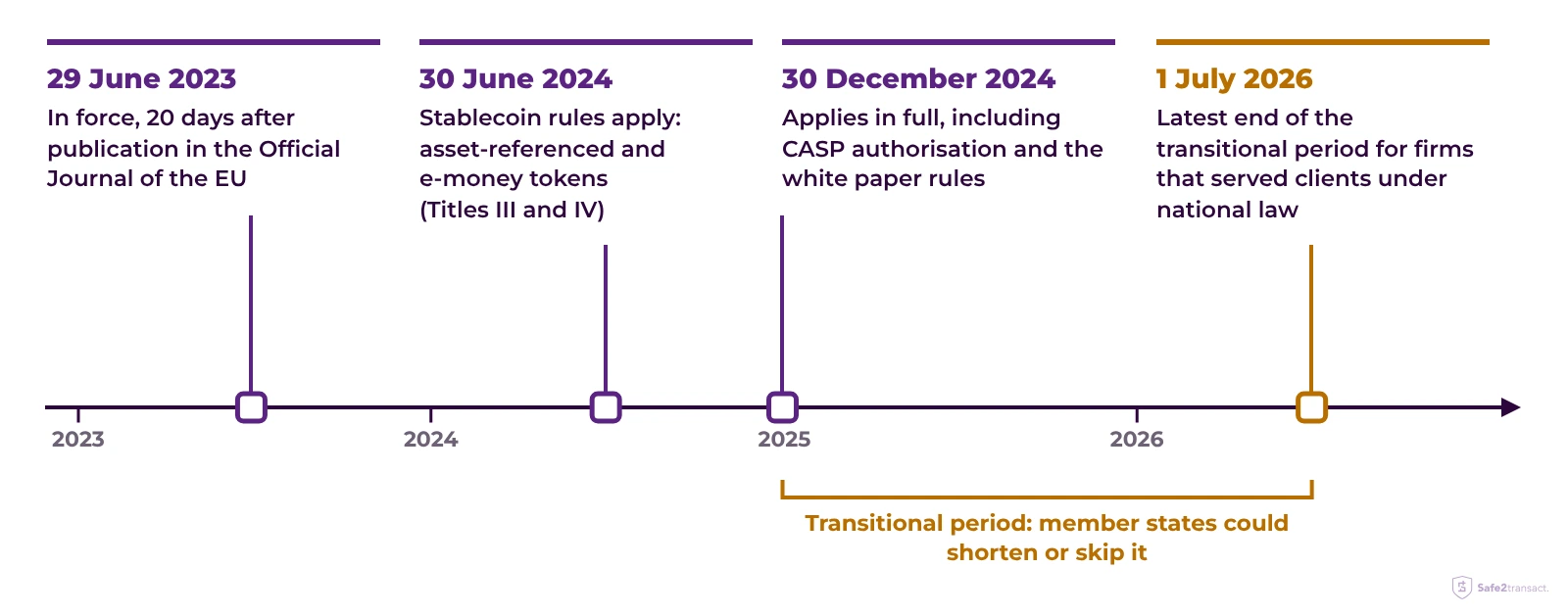
MiCA has applied in full since 30 December 2024; the stablecoin rules started earlier, on 30 June 2024. The dates come from Article 149 and the transitional rules in Article 143:
- 29 June 2023: in force, 20 days after publication in the Official Journal of the EU.
- 30 June 2024: Titles III and IV apply, the rules for asset-referenced tokens and e-money tokens.
- 30 December 2024: everything else applies, including the authorisation of CASPs and the white paper rules.
- 1 July 2026: the latest end of the transitional period for firms that served clients under national law before 30 December 2024. Member states could shorten it or skip it, so in some countries it ended earlier.
Since then, according to the European Securities and Markets Authority (ESMA), a firm offering crypto-asset services to EU clients without a MiCA licence breaches EU law and must stop.
Which crypto-assets does MiCA cover?
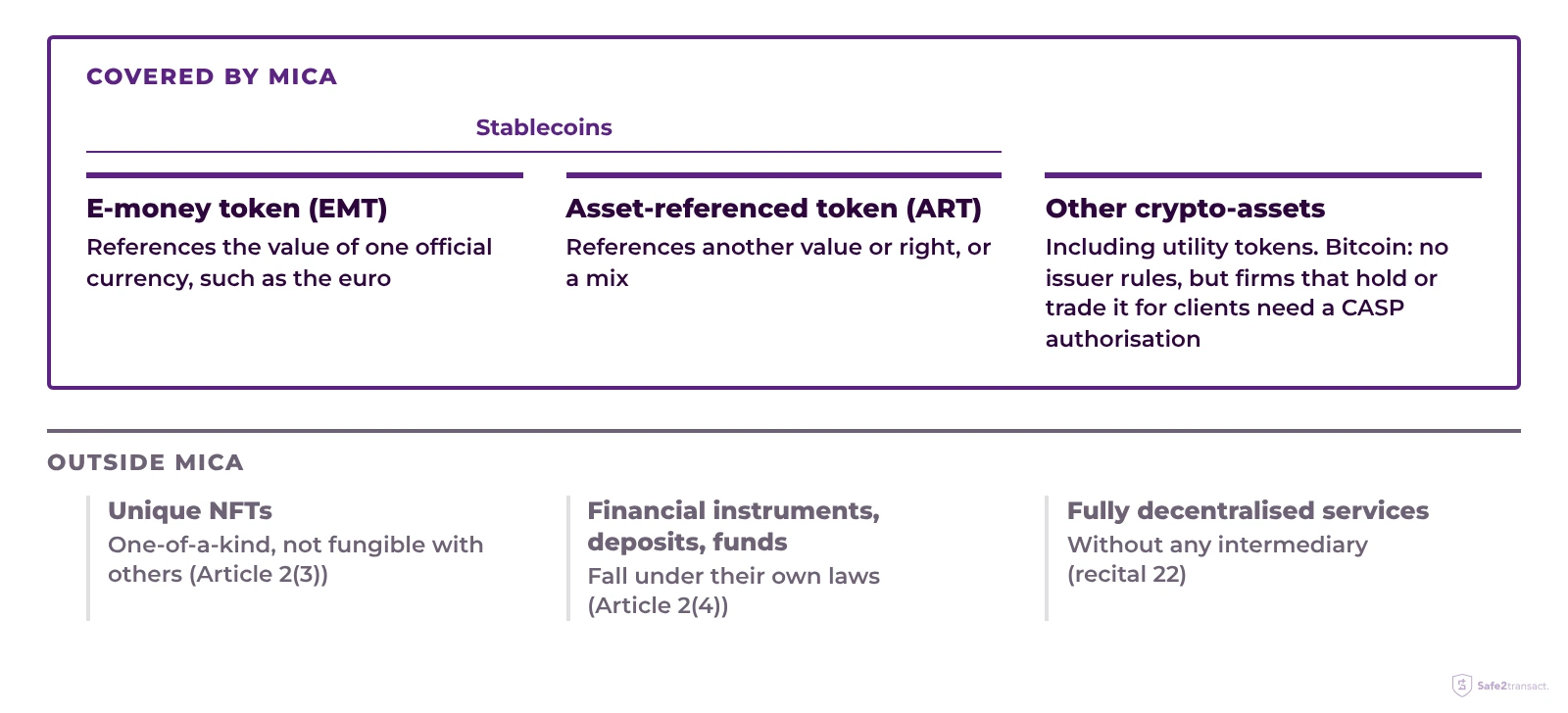
MiCA sorts crypto-assets into three groups: e-money tokens, asset-referenced tokens and all other crypto-assets. E-money tokens and asset-referenced tokens are the two kinds of stablecoin; the third group includes utility tokens, which only give access to a good or service of their issuer (Article 3(1)(9)).
| E-money token (EMT) | Asset-referenced token (ART) | Other crypto-assets | |
|---|---|---|---|
| What it references | The value of one official currency, such as the euro | Another value or right, or a mix, such as a basket of currencies or gold | Nothing fixed: the price is set by the market |
| Who may issue or offer it | Only a bank or an electronic money institution issues it (Article 48) | An issuer authorised by its national authority, or a bank (Article 16) | Any legal person, after publishing a white paper (Article 4) |
| What backs it | A claim on the issuer, redeemable at any time at par, without a fee (Article 49) | A reserve of assets, legally segregated from the issuer's own estate (Article 36) | No reserve required |
| Interest | Banned, also from service providers (Article 50) | Banned, also from service providers (Article 40) | No MiCA rule |
| Applies since | 30 June 2024 | 30 June 2024 | 30 December 2024 |
An e-money token counts as electronic money under EU law (Article 48(2)). A stable price is still only the issuer's aim, not a guarantee from any public scheme.
What does MiCA leave out?
MiCA doesn't apply to crypto-assets that are unique and not fungible with others, such as one-of-a-kind NFTs (Article 2(3)). Crypto-assets that count as financial instruments, deposits or funds fall under their own laws (Article 2(4)). Services provided in a fully decentralised way, without any intermediary, are outside the regulation (recital 22). A crypto-asset with no identifiable issuer, such as bitcoin, escapes the issuer rules, but every firm that holds or trades it for clients still needs a CASP authorisation.
What is a crypto-asset service provider (CASP)?
A crypto-asset service provider (CASP) is a legal person whose business is providing crypto-asset services to clients and which is allowed to do so under Article 59 of MiCA. MiCA lists ten crypto-asset services (Article 3(1)(16)): custody and administration of crypto-assets for clients, operating a trading platform, exchanging crypto-assets for funds, exchanging crypto-assets for other crypto-assets, executing orders, placing crypto-assets, receiving and transmitting orders, advice, portfolio management, and transfer services.
A CASP needs a registered office in an EU member state, its place of effective management in the EU and at least one director resident in the EU (Article 59(2)). Banks, electronic money institutions, investment firms and some other regulated firms only need to notify their authority (Article 60). Each authorisation names the services it covers (Article 59(6)), and a firm that isn't a CASP may not present itself as one (Article 59(5)).
An authorisation in one member state is valid across the EU: the CASP notifies its home authority, which informs the other countries within 10 working days, and the CASP may start there by the 15th calendar day at the latest (Article 65).
Every CASP must:
- act honestly, fairly and professionally in its clients' best interests, warn them of the risks and publish its fees (Article 66);
- safeguard clients' crypto-assets and keys, especially in its own insolvency, and never use them for its own account (Article 70(1));
- place clients' money with a bank or a central bank by the end of the next business day (Article 70(3)).
Who supervises crypto under MiCA?
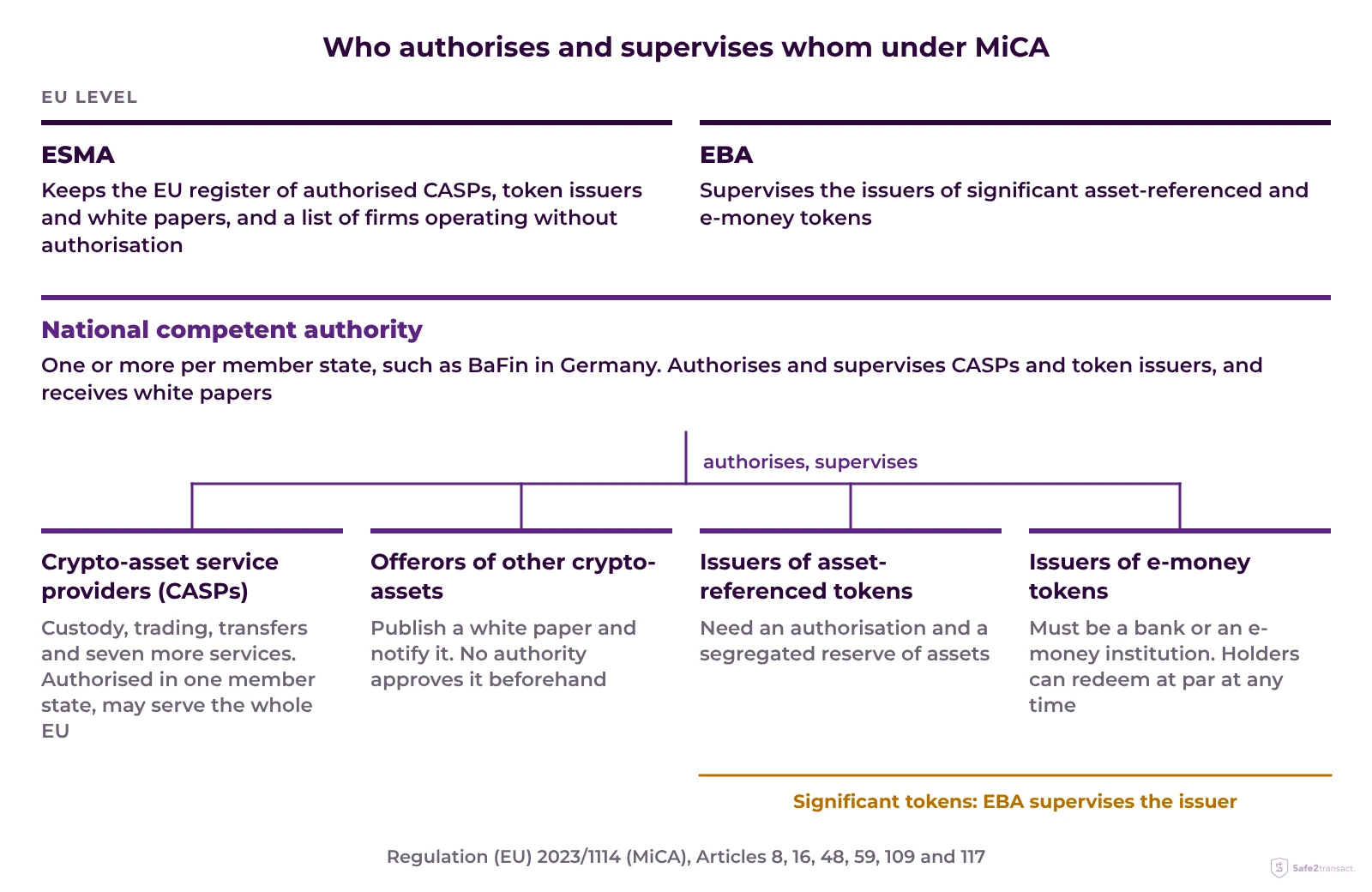
National competent authorities authorise and supervise CASPs and token issuers; ESMA and EBA coordinate at EU level. In Germany the authority is BaFin; each member state names one or more (Article 93). ESMA keeps the public register of white papers, token issuers and CASPs (Article 109) and a list of firms providing crypto services without authorisation (Article 110), which isn't complete. The European Banking Authority (EBA) directly supervises the issuers of significant asset-referenced tokens and significant e-money tokens (Article 117). Both may temporarily ban or restrict a crypto product across the EU (Articles 103 and 104).
What do white papers and marketing rules require?
A crypto-asset white paper is the disclosure document an offeror must publish before offering a token to the public in the EU: it describes the issuer, the project, the rights attached, the technology, the risks and the climate impact (Article 6). Except for asset-referenced tokens, whose white paper is part of the issuer's authorisation, no authority approves it in advance (Article 8(3)), and its first page has to say so. The white paper may not make claims about the token's future value, and it must state that the token may lose its value in part or in full and isn't covered by investor compensation or deposit guarantee schemes (Article 6(4) and (5)).
Small offers need no white paper: fewer than 150 people per member state, at most EUR 1,000,000 over 12 months, or qualified investors only (Article 4(2)).
Marketing for any crypto-asset must be clearly identifiable as marketing, fair, clear and not misleading, consistent with the white paper, and must say where the white paper is published (Articles 7, 29 and 53). No marketing may start before the white paper is out (Article 7(2)). Marketing for an e-money token must also state the holder's right to redeem it at par at any time (Article 53(2)).
You check a crypto provider by finding the legal entity behind the brand and looking that entity up in ESMA's Interim MiCA Register, the EU list of authorised CASPs. ESMA updates the register weekly; a withdrawn authorisation stays listed with its withdrawal date.
Check that the company you are using is listed as authorised in the ESMA Interim MiCA Register before you invest or transfer funds.
Find the legal entity
Look in the provider's terms, your contract or the website footer for the full company name and its country. A brand name alone isn't enough.
Search ESMA's Interim MiCA Register
Open the list of crypto-asset service providers on the ESMA website and search for the legal name, not the brand.
Match the services
Check that the entry lists the service you want, such as custody or exchanging crypto-assets for funds.
Confirm with the national authority
The entry names the authority that granted the authorisation, such as BaFin in Germany. Its own company database confirms the entry.
ESMA adds that MiCA protections apply only to the specific authorised legal entity in the EU, not to other companies of the same group or to non-EU entities, and that one brand may operate through several companies. A firm based outside the EU may serve an EU client only when that client approached it entirely on their own initiative; any solicitation in the EU ends that exception (Article 61).
Safe2transact shows what to look for. Crypto services are provided by BitGo Europe GmbH, a CASP authorised under MiCA and supervised by BaFin, so BitGo Europe GmbH is the entity to search for. Safe2transact's Help article on complaints and how your money is protected names the provider behind each service.
What doesn't MiCA protect?
MiCA doesn't protect the value of crypto-assets: they aren't covered by deposit guarantee or investor compensation schemes, and a price can fall to zero. MiCA protects ownership instead: an authorised CASP must safeguard clients' crypto-assets if it fails (Article 70), but nobody makes good a market loss. A promise of fixed returns is a warning sign, since a guaranteed profit is a hallmark of investment fraud.
Frequently asked questions
Does MiCA apply to crypto in my own wallet?
No. MiCA regulates the firms that issue, offer or provide services with crypto-assets. Crypto held in a self-hosted wallet involves no provider, so no MiCA rule protects it, and the security of the keys is up to you.
Does MiCA include the Travel Rule?
No. The Travel Rule is in a separate law, the Transfer of Funds Regulation (EU) 2023/1113, which also applies since 30 December 2024. It makes identity data travel with every crypto transfer between providers. For a transfer above EUR 1,000 to or from your own wallet, the provider checks that the wallet is yours.
Does MiCA cover crypto taxes?
No. Tax on crypto gains is set by each country. A separate EU directive, DAC8 (Council Directive (EU) 2023/2226), has required CASPs since 1 January 2026 to collect their clients' transaction data for reporting to tax authorities.