What is an IBAN?
An IBAN (International Bank Account Number) is the standard number that identifies one payment account in transfers and direct debits. It has up to 34 characters: a country code, two check digits and the account's national number.
What is an IBAN?
An IBAN, short for International Bank Account Number, is a code of up to 34 letters and digits that identifies a single payment account across borders.
SWIFT keeps the official registry of each country's IBAN format. More than 80 countries use IBANs: almost all of Europe, much of the Middle East, and countries such as Brazil and Pakistan, but not the United States, Canada or Australia.
In EU law, the SEPA Regulation (EU) No 260/2012 defines the IBAN as the identifier "which unambiguously identifies an individual payment account in a Member State": the one account number every euro payment in the Single Euro Payments Area relies on.
How is an IBAN built?
Every IBAN has four parts, always in the same order: country code, check digits, bank code and account number.
- Country code: two letters from ISO 3166, such as LT for Lithuania or NL for the Netherlands.
- Check digits: two digits calculated from all the other characters.
- Bank code: the bank or payment institution that holds the account, in some countries followed by a branch code.
- Account number: the account at that institution, in a few countries with national check digits of its own.
Parts 3 and 4 together are the BBAN, the account number as it's written inside the country: a Polish IBAN is PL, two check digits and the 26-digit account number Poles use at home.
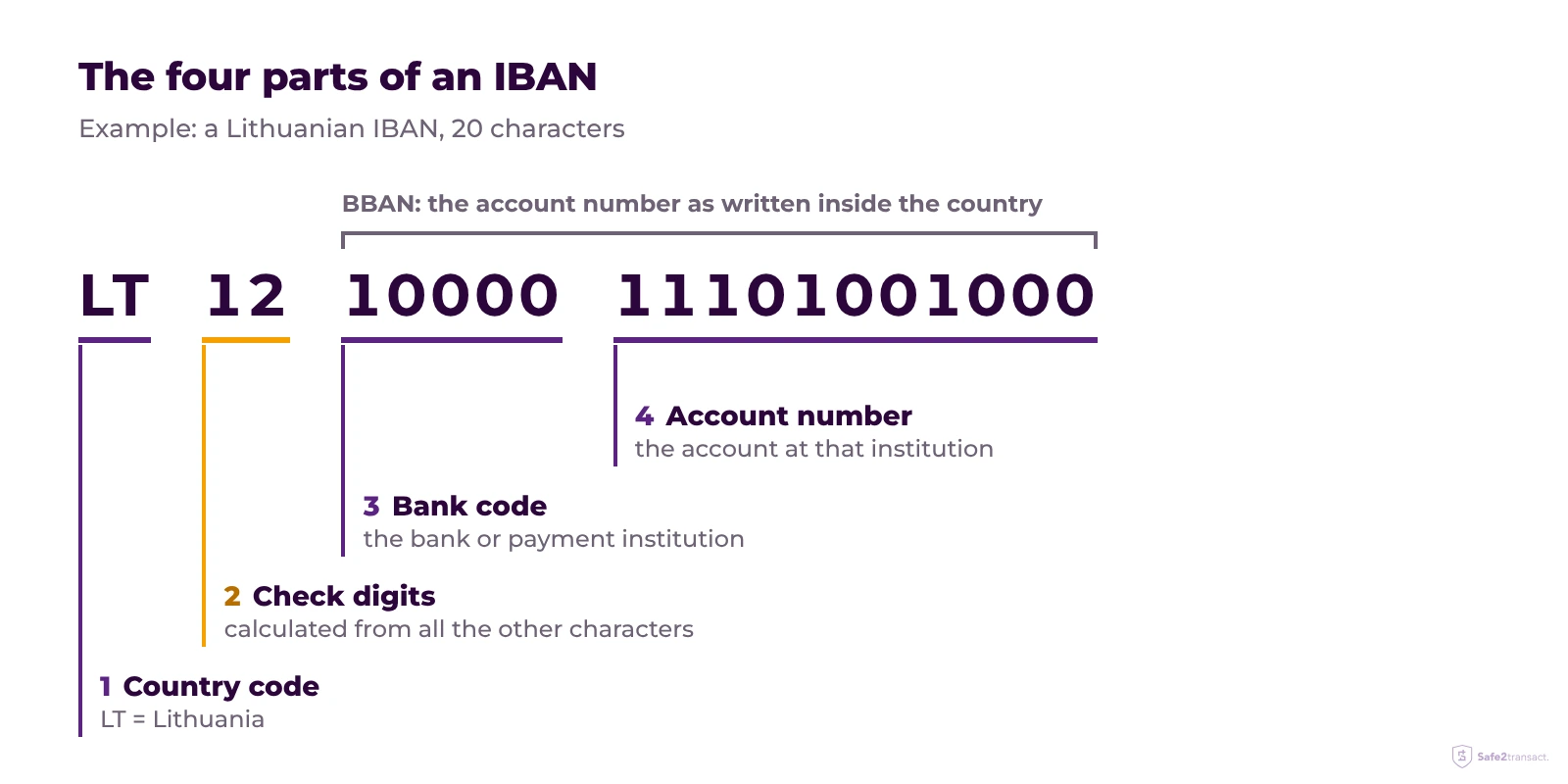
On paper and on screen, an IBAN is written in groups of four (LT12 1000 0111 0100 1000); most payment forms remove the spaces for you.
How do the check digits work?
The two check digits make the whole IBAN, read as one large number, leave a remainder of exactly 1 when divided by 97. The method is MOD 97-10 (ISO 7064):
Move the first four characters to the end
LT12 1000 0111 0100 1000 becomes 1000011101001000LT12.
Replace each letter with a number
A becomes 10, B 11, and so on to Z = 35. L is 21 and T is 29, so the string becomes 1000011101001000212912.
Divide by 97 and look at the remainder
1000011101001000212912 divided by 97 leaves 1, so the IBAN is correctly formed. Any other remainder means a mistake.
Because 97 is a prime larger than any character's value, a single changed character always changes the remainder, and almost every swap of two neighbouring characters does too. The check can't tell whether the account exists or whose it is.
How long is an IBAN?
An IBAN's length depends on the country and is the same for every account there: Norway has the shortest in SEPA at 15 characters, Malta the longest at 31.
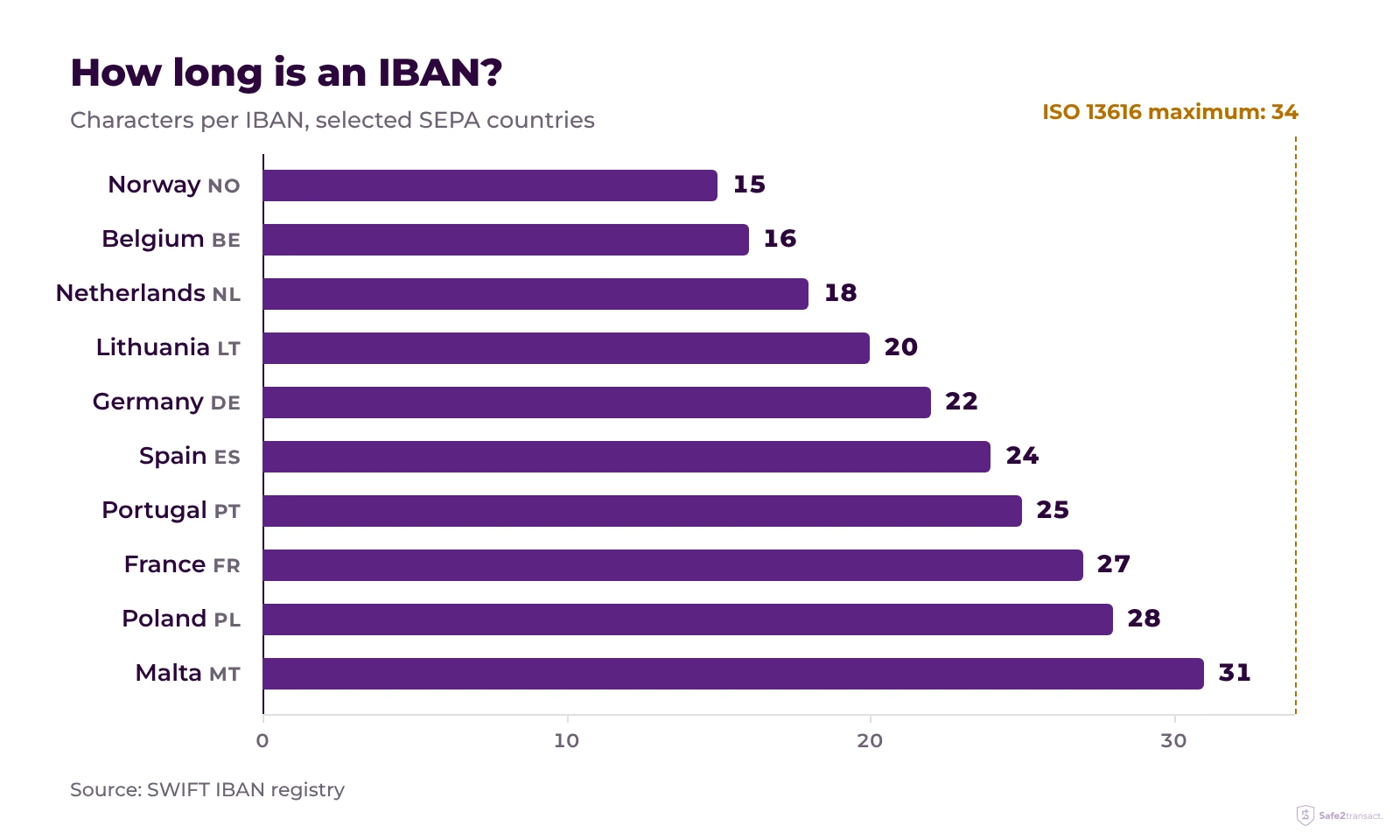
So an IBAN that starts with DE but has 21 characters is wrong before any check digit is calculated.
Where do you need an IBAN?
You need an IBAN wherever money moves between payment accounts in euro: to send it, to receive it, or to let someone collect it.
- Transfers: a SEPA credit transfer, standard or instant, needs the payee's IBAN and name in all 41 countries of the SEPA schemes.
- Salary and benefits: employers, pension funds and tax offices pay into the IBAN you give them.
- Direct debits: a mandate for rent, energy or a phone contract gives the company your IBAN to collect each bill.
- Refunds and incoming payments: shops, marketplaces and friends abroad pay back to your IBAN.
Under Article 9 of the SEPA Regulation, a payer or payee in the EU must accept an IBAN from any other EU country that can receive SEPA payments: an employer in the Netherlands can't insist on a Dutch IBAN, and a Polish utility can't refuse a Lithuanian one. Refusing a foreign IBAN is called IBAN discrimination, and national authorities handle complaints about it.
What is the difference between an IBAN and a BIC?
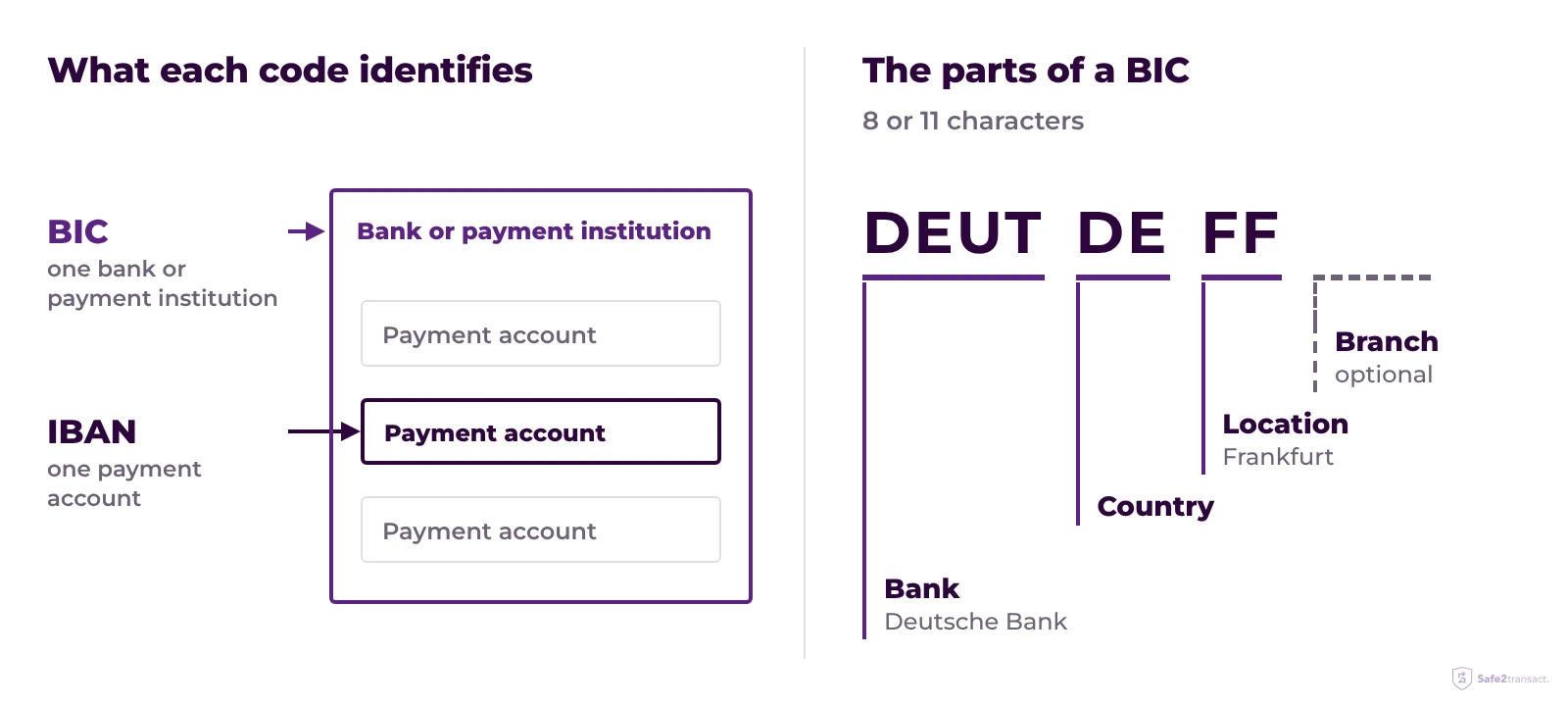
The IBAN identifies the account; the BIC identifies the bank or payment institution that holds it.
| IBAN | BIC (SWIFT code) | |
|---|---|---|
| Identifies | One payment account | One bank or payment institution |
| Standard | ISO 13616 | ISO 9362 |
| Length | Fixed per country, up to 34 characters | 8 or 11 characters |
| Example | LT12 1000 0111 0100 1000 | DEUTDEFF (Deutsche Bank, Frankfurt) |
| Needed for a SEPA payment | Yes | No |
| Needed outside SEPA | Often, together with the BIC | Usually, for SWIFT payments |
The BIC (Business Identifier Code, often called the SWIFT code) reads as bank, country, location and an optional branch: DEUT, DE, FF. Since 1 February 2016, the SEPA Regulation (Article 5(7)) has barred payment providers from asking consumers for a BIC on any SEPA payment, domestic or cross-border, because the IBAN already points to the right institution.
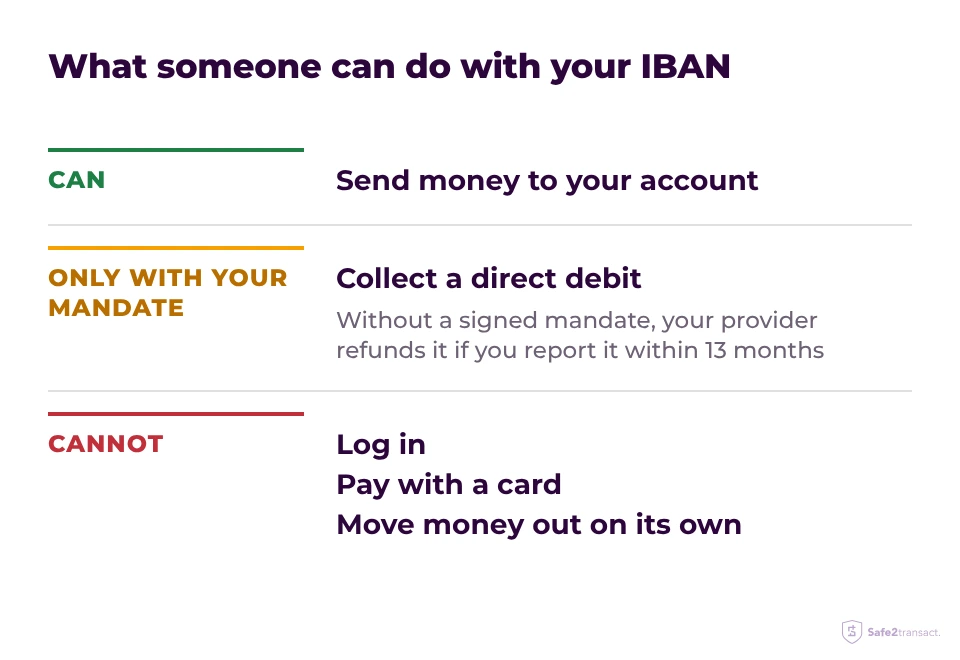
Yes: an IBAN can't be used to log in, to pay with a card or to move money out on its own.
An IBAN tells a payer where to send money. It doesn't let anyone take money out.
The risks lie around the IBAN, not in it:
- Direct debits in your name. A company needs a signed mandate to collect from your IBAN. Your provider must refund a debit without one if you report it within 13 months (Payment Services Directive (EU) 2015/2366, Article 71), and even an authorised SEPA Core direct debit can be refunded for 8 weeks, no questions asked.
- Combined with identity documents. An IBAN plus a copy of your ID or a selfie gives a fraudster more to work with, so send ID documents only to parties you've checked.
- Fake "new bank details". The most costly IBAN fraud works the other way round: a fake email or invoice asks you to pay a supplier, landlord or relative at the fraudster's IBAN.
How do you find your IBAN?
Your IBAN is in your banking or payment app, usually on the account's details screen, and on your statements and account contract. It isn't printed on a payment card: the long number there is the card number.
A Safe2transact IBAN account is a Lithuanian IBAN, so it starts with LT and has 20 characters; in the app it's under IBAN → Details, next to the BIC. If you don't have one yet, here's how to request your IBAN.
What are the most common IBAN mistakes?
The most common mistake is a single wrong or missing character, and the check digits catch it before the payment leaves. They miss the others:
- A valid IBAN that belongs to someone else. An IBAN copied from an old message or from a fraudster passes the check digits. Since 9 October 2025, providers in the euro area must compare the payee's name with the IBAN before a euro transfer (Instant Payments Regulation (EU) 2024/886), and show you whether the name matches, nearly matches or doesn't match. Here's what each payee name check result means.
- Letters and digits mixed up. O and 0, or I and 1, look alike, and Dutch IBANs have letters in the bank code (NL91 ABNA …).
- The national number instead of the IBAN. A payer in another country needs the full IBAN, with PL in front of a Polish account number.
- A card number or a BIC in the IBAN field. Both fail the IBAN check.
Frequently asked questions
Does my IBAN show my name or my balance?
No. An IBAN holds only a country code, check digits, a bank code and an account number. The name check before a transfer only answers whether a name matches the account; it reveals no balance or other personal data.
Does an IBAN ever change?
Not while the account exists. You get a new one with a new account or provider, and occasionally when banks merge and renumber accounts, which the bank announces in advance.
Do I need an IBAN to receive money from outside Europe?
A payer outside SEPA usually sends a SWIFT payment, which needs your IBAN and your provider's BIC. Whether a particular account accepts SWIFT payments, and in which currencies, depends on the provider.
IBAN and Visa card issuance and payment services are provided by Stanhope Financial UAB, a company registered in Lithuania (a member state of the European Union) with company code 305574870 and a registered address at Konstitucijos pr. 7, Vilnius, Lithuania. Stanhope Financial UAB is an Electronic Money Institution (EMI licence No. 78) authorized and regulated by the Bank of Lithuania. Access to your IBAN account and your VISA card is technically provided through the Safe2transact platform.